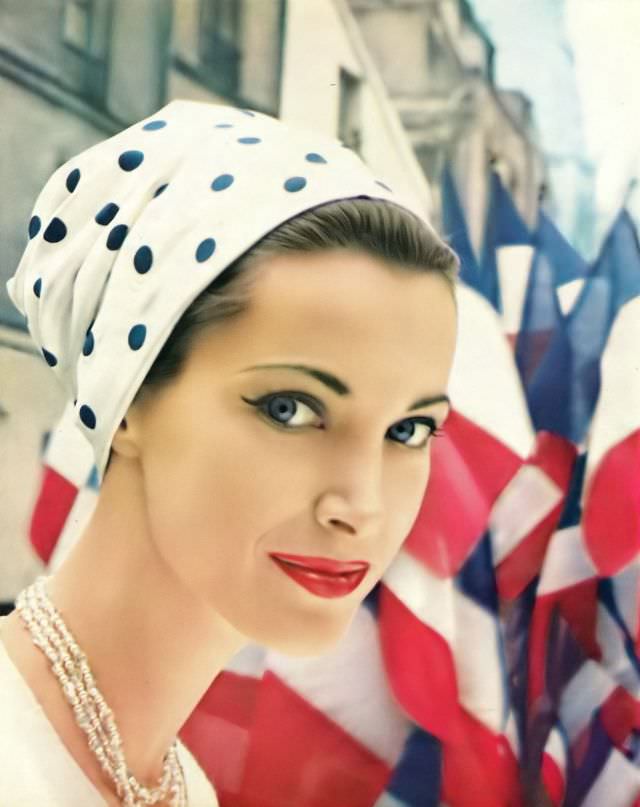
Ann Farrar’s face fills the frame with the poised clarity of late-1950s Vogue glamour, her gaze direct and immaculate beneath a white headscarf dotted in navy. A strand of pearls and a crisp red lip underline the era’s promise of “instant beauty,” while precise eyeliner and arched brows give her expression a confident, editorial sharpness. The close-up composition turns cosmetics into narrative, making the viewer linger on texture, color, and the polished calm of a model at work.
Behind her, a blur of French tricolor flags and pale stone façades suggests a street scene in France without pinning it to a single recognizable corner. The flags ripple as soft blocks of blue, white, and red, adding motion and national symbolism that echoes the ad’s message of chic European refinement. Derujinsky’s shallow depth of field separates the subject from the city, turning Parisian atmosphere—suggested rather than specified—into a stylish backdrop for beauty marketing.
Published in Vogue on March 15, 1959, the Coty advertisement reflects a moment when fashion photography fused commercial persuasion with high-art finish. The image balances intimacy and spectacle: a near-portrait that still carries the pageantry of mid-century magazine culture, travel, and aspirational femininity. For collectors and researchers of vintage Vogue, Gleb Derujinsky’s fashion photography, and 1950s cosmetics advertising, it stands as a luminous example of how editorial aesthetics helped define modern beauty branding.