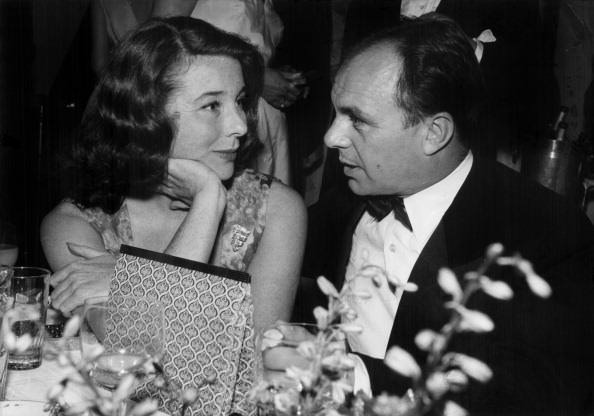
June 1957 finds Bettina Graziani seated close beside Ali Khan at a dinner table, caught mid-conversation in a candid moment that feels both public and intimate. Her head rests lightly on her hand as she turns toward him, a poised expression suggesting the practiced ease of someone accustomed to cameras and crowded rooms. He leans in attentively in formal evening wear, the crisp bow tie and dark jacket signaling the ceremonial glamour of postwar high society.
Across the foreground, glasses and table settings glint under soft light, while a blur of floral décor frames the couple and reinforces the setting as a fashionable social event. The composition draws the eye to their faces—her softly waved hair and sleeveless dress contrasted with his polished tuxedo—capturing the era’s ideals of elegance and restraint. Background figures dissolve into shadow, hinting at a busy room without stealing focus from the exchange at the center.
Seen today, the photograph reads as a small window into 1950s fashion and culture, when models, aristocrats, and celebrities often moved through the same salons and soirées. Bettina’s presence evokes her status as an early French supermodel, while Ali Khan’s profile adds to the period’s aura of cosmopolitan intrigue. Together they embody the mid-century blend of couture, celebrity, and social ritual that continues to shape how we imagine the glamour of the late 1950s.