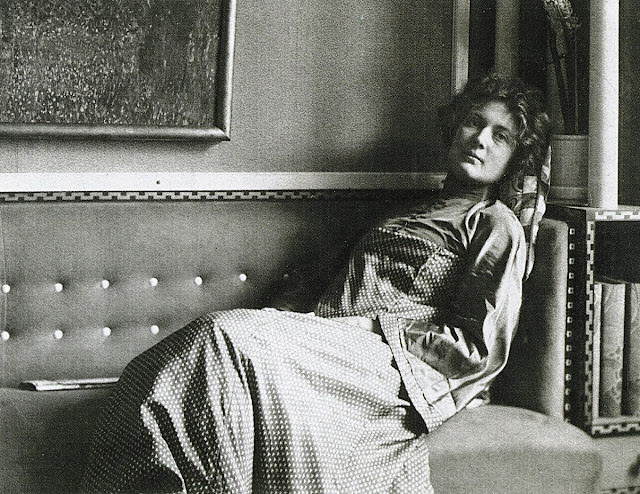
Reclining along a tufted bench, a woman meets the camera with an unguarded, slightly weary poise, her body turned sideways as fabric pools in soft folds across her lap. The dress reads as deliberately modern for its era: loose through the torso, patterned with small dots, and finished with relaxed sleeves that suggest comfort as a design principle rather than an afterthought. Behind her, the room’s framed artwork and geometric trim hint at an interior where aesthetics mattered, aligning private space with the broader language of art and design.
Emilie Flöge’s fashion career is often discussed in terms of reform dress and the push away from rigid, corseted silhouettes, and this rare photo helps make that shift feel tangible. The garment’s ease and drape emphasize movement, personality, and lived-in elegance—qualities that would have resonated with clients seeking something beyond convention. Even the candid, studio-adjacent atmosphere carries the sense of a creative world in motion, where clothing, interiors, and visual culture fed one another.
For readers drawn to fashion history and cultural change, the photograph works as both portrait and evidence, suggesting how progressive style could be worn at home as naturally as it might be displayed in a salon. Texture, pattern, and posture combine to tell a story about autonomy—how a dress could signal new ideas about women’s bodies and public presence without sacrificing beauty. As part of a larger collection of rare images, it underscores why Emilie Flöge remains a compelling figure at the intersection of fashion & culture, where personal image becomes a quiet form of modern statement.