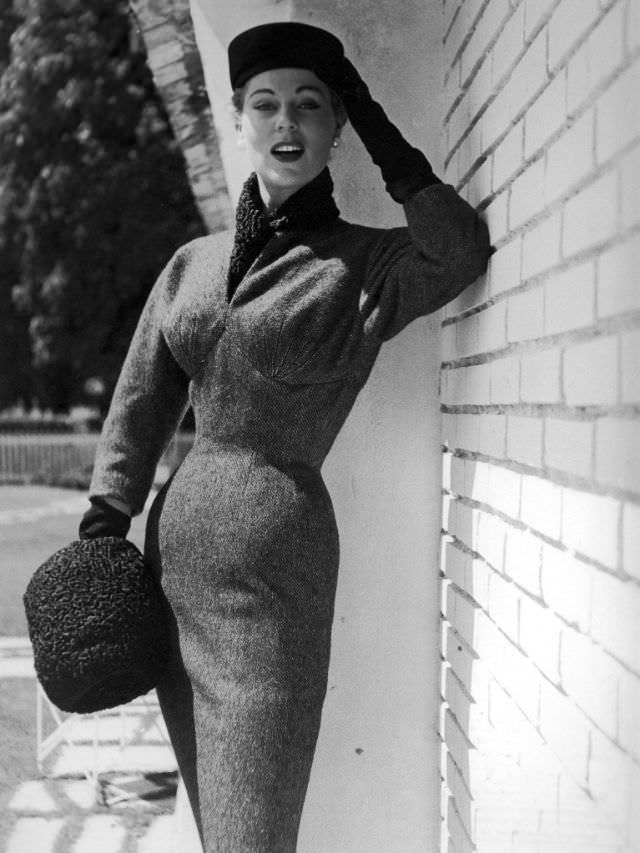
Leaning against a sunlit brick wall, Stella holds a poised, mid-stride confidence that feels unmistakably 1953. The tweed dress—close-fitting through the waist and hips—speaks to postwar tailoring at its most disciplined, shaping the body with clean seams rather than ornament. A small hat, dark gloves, and a textured muff add a polished finish, while the open mouth and lifted chin give the pose a lively, editorial immediacy instead of a frozen studio formality.
Jacques Fath’s influence comes through in the balance of elegance and attitude: refined materials paired with an assertive silhouette meant for modern city life. The lamb scarf and muff introduce a winter-luxury note, softening the graphic line of the suit and emphasizing the era’s taste for tactile contrasts—wool against fur, matte against sheen. Even in black and white, the fabric textures read clearly, making the photograph as much a study in surfaces as in style.
Beyond the clothes, the setting hints at fashion’s expanding relationship with everyday architecture and outdoor light, moving away from heavy backdrops toward a more natural scene. Stella’s look fits neatly into mid-century fashion and culture, when American modeling increasingly translated Paris couture into aspirational imagery for magazines and advertisements. The result is a classic vintage fashion moment: controlled glamour, crisp tailoring, and a woman presented not as decoration, but as presence.