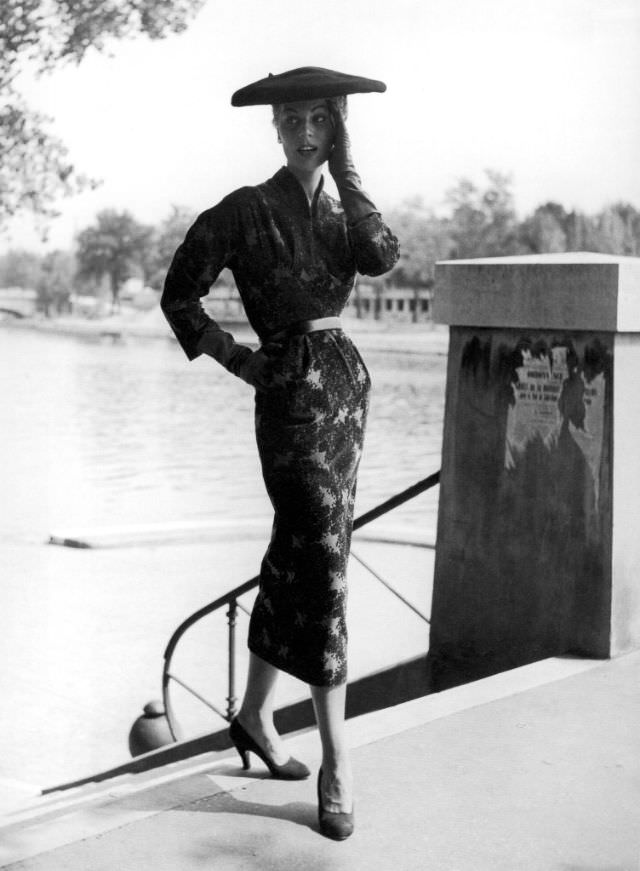
Poised on a riverside promenade, Stella turns slightly toward the light, one gloved hand lifting to her face as if caught mid-thought. The elongated line of her silhouette—nipped at the waist and tapered through the skirt—sets a distinctly 1950s rhythm, while the wide, flat hat adds a note of drama that frames her gaze. Behind her, water and distant trees soften into a hazy backdrop, letting the figure and outfit read with runway clarity even in an outdoor setting.
Madeleine de Rauch’s fall/winter design, described as a printed velvet dress, plays with texture and pattern in a way that would have felt luxurious against the season’s chill. The fabric’s dark motif catches and releases the light, emphasizing the structured bodice, the sleek three-quarter sleeves, and the controlled elegance of a pencil skirt designed for measured steps. Finished with high heels and long gloves, the look balances couture polish with practical warmth—an ensemble meant to be seen, not merely worn.
Paris in 1953 was a stage where fashion and culture intertwined, and this photograph leans into that theatrical confidence without needing a salon interior to prove its pedigree. The stone railing and open air suggest modernity and movement, a city life where couture could travel beyond the atelier and into public view. For readers interested in mid-century French fashion photography, postwar couture, and the era’s model-led storytelling, Stella’s appearance here offers a crisp snapshot of how elegance was posed, marketed, and remembered.