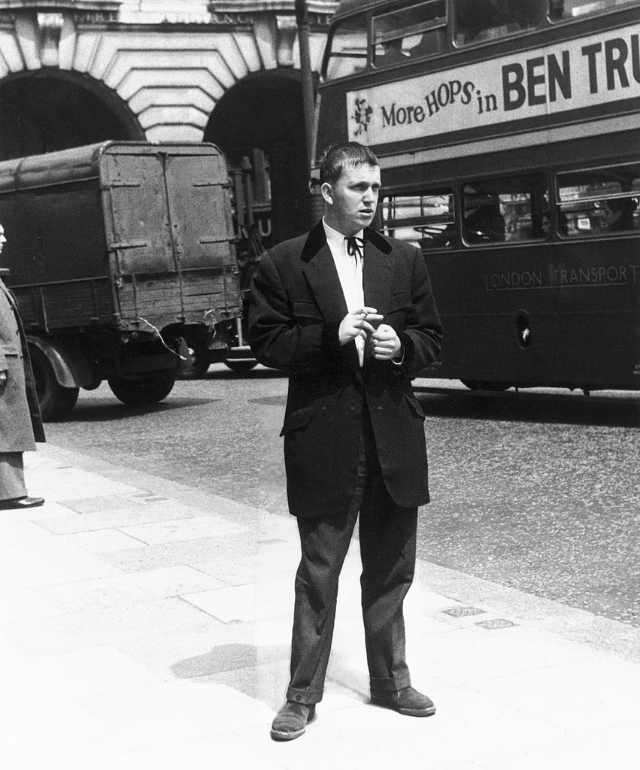
Lean and self-assured on a city pavement, a young British Teddy Boy stands apart from the bustle in his trademark “drape” suit, the long jacket hanging with deliberate weight and a dark velvet collar framing a crisp white shirt. The narrow tie and carefully cut trousers complete a silhouette that nods to Edwardian tailoring while declaring something unmistakably modern and youthful. His stance—hands busy at mid-chest as if adjusting a cigarette or cuff—adds to the sense of performance that made Teddy Boy fashion as much attitude as clothing.
Behind him, everyday street life rolls on: a double-decker marked “London Transport” glides past, and the curve of a stone archway suggests a busy urban thoroughfare where buses, lorries, and pedestrians share the frame. The advertising on the bus, partially readable, anchors the scene in mid-century Britain and lends it a documentary feel, as though the camera simply caught a moment when style collided with routine. That contrast—sharp tailoring against industrial traffic and public transit—helps explain why Teddy culture drew so many eyes in the 1950s.
More than a portrait of menswear, the photograph speaks to post-war British youth culture and the rise of subcultural identity through dress. The drape suit, with its exaggerated lines and polished details, was a statement of independence in a time when conformity still carried social weight. For anyone searching the history of Teddy Boys and 1950s British fashion, this street-level glimpse offers the era’s defining mix of elegance, bravado, and public presence.