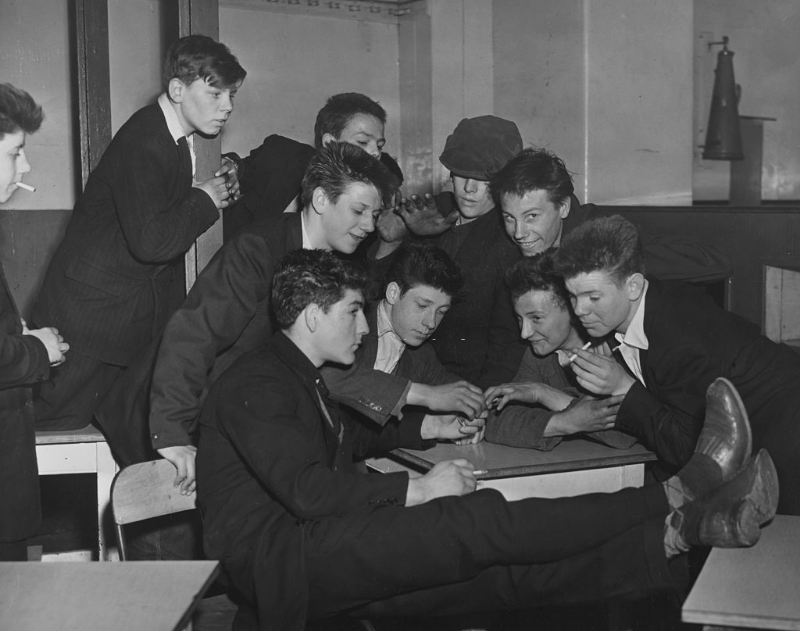
Clustered tightly around a table at the Rodney Youth Centre in Liverpool, a group of Teddy Boys lean in with the conspiratorial ease of close friends, cigarettes glowing between fingers and lips. Their faces—half-smiling, half-serious—turn toward something small and shared at the centre of the gathering, while one lad stretches out with his boots up, claiming space with the relaxed swagger so often linked to mid-century youth style. The room itself feels plain and utilitarian, making their sharp silhouettes and animated posture stand out even more.
Edwardian-inspired drape jackets, crisp shirts, and carefully sculpted quiffs signal the unmistakable Teddy Boy look, polished enough to be a statement even in a modest youth club setting. A flat cap among the group adds variety to the ensemble, hinting at how individual flair mixed with a recognizable uniform. More than fashion, the styling reads as identity—an assertion of taste, belonging, and modern cool in 1950s Britain.
Taken in April 1956, the scene sits squarely within the era when Teddy Boy culture drew fascination and anxiety in equal measure, celebrated for its style and scrutinized for its attitude. What comes through here is the everyday texture of youth subcultures: mates crowding together, passing time, trading jokes, and performing confidence for one another. For anyone searching vintage Liverpool history, 1950s youth culture, or authentic Teddy Boys photography, this moment offers an intimate glimpse of how rebellion could look—smoke, suits, and camaraderie inside a community space.