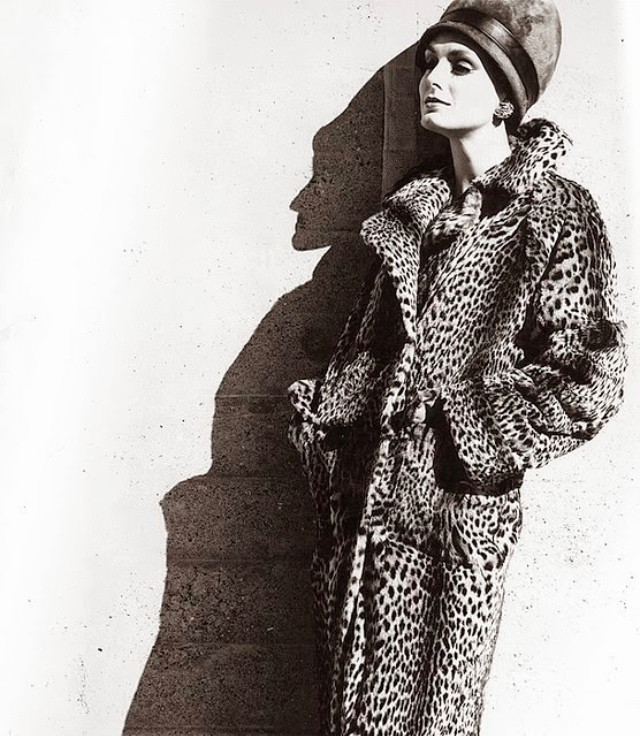
A model leans against a sunlit wall in a leopard-print coat, her hands tucked into deep pockets as a sculptural hat crowns the look with mid-century confidence. The real drama, though, is cast beside her: a crisp shadow that doubles the profile and turns a simple stance into a study of shape and attitude. High contrast, clean space, and controlled styling evoke the editorial precision associated with 1950s fashion photography.
Behind the elegance is the craft of the photoshoot—lighting placed to carve out cheekbones, fabric texture emphasized so it reads on the page, and a pose designed to suggest a life just beyond the frame. The coat’s bold pattern does the work of visual storytelling, while the minimal background keeps the eye on silhouette, accessories, and that carefully composed negative space. It’s the kind of image language that defined glossy magazine spreads, where fashion was presented as modern art as much as wardrobe.
Beyond the Pose explores how publications like Vogue and Harper’s Bazaar turned clothing into narrative through composition, mood, and a photographer’s command of tone. This post looks at the editorial techniques that made 1950s style feel simultaneously aspirational and tangible—luxury rendered in light, shadow, and a single decisive gesture. For readers drawn to vintage glamour, mid-century couture, and fashion history, the photograph offers a compact lesson in how magazines built iconography one frame at a time.