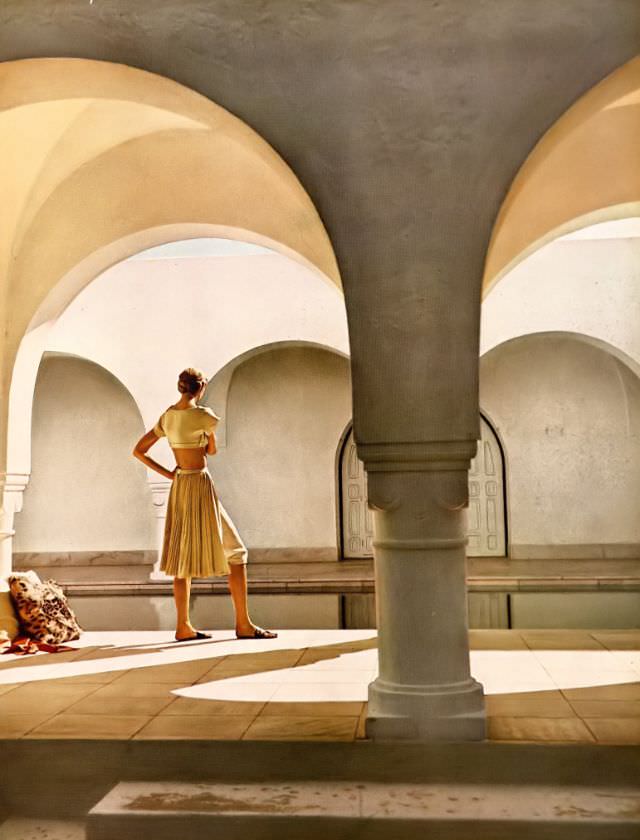
Under a rhythm of pale arches and deep shadow, Natalie Paine stands poised with her back turned, framed by a central column that divides the scene like a stage set. The bleached beige high, tiny top leaves her shoulders cleanly outlined, while the ingenious skirt-and-knickers combination falls in soft pleats and then reveals its practical understructure at the knee. Warm light skims the tiled floor and catches the outfit’s quiet sheen, emphasizing how couture can look effortless while being carefully engineered.
The setting reads as a serene courtyard or colonnade, its smooth plaster curves and recessed doorways lending a Mediterranean calm without pinning the moment to a specific place. Strong architectural symmetry contrasts with the garment’s movement: the skirt hangs with sculptural discipline, yet suggests ease for walking, travel, and modern life. Even the absence of close facial detail keeps attention on silhouette, proportion, and the dialogue between body and cloth.
In June 1950, the design attributed to Grès speaks to a postwar haute couture imagination that prized both classical line and inventive construction. The inseparable joining of skirt and knickers hints at the era’s flirtation with sport, resort, and youthful utility, translated into the elevated language of couture draping. Fashion and culture meet here in a single quiet pose—an image built for editorial impact, but also a lasting record of mid-century style thinking at its most refined.