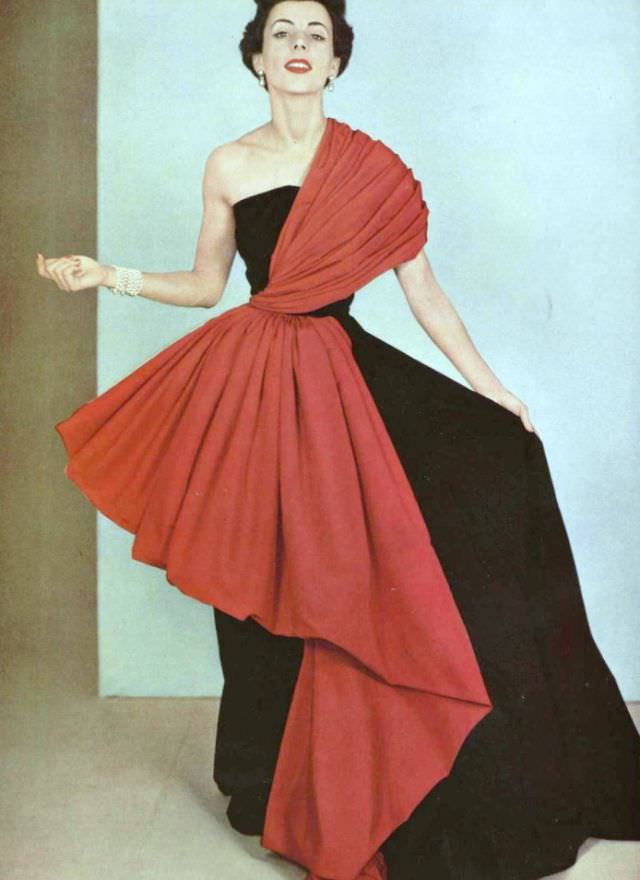
A poised model stands against a plain studio backdrop, letting the dress do the talking: a striking composition of red faille draped over a black faille gown, attributed in the title to Grès and dated to 1950. The red fabric sweeps diagonally across one shoulder like a sash, then spills into sculpted folds that flare outward before cascading down the front. Her lifted chin, dark coiffed hair, and bright lipstick sharpen the sense of mid-century elegance, while a sparkling bracelet catches the light at her wrist.
The design reads like wearable architecture, built from tension and flow—black forming a sleek, grounded column and the red providing drama through disciplined pleating. Faille’s crisp hand is essential here, holding the deep ridges of each fold and giving the drapery a controlled, almost classical rhythm. With one hand she gathers the skirt to show its volume and movement, emphasizing how couture relied on the body in motion as much as on the mannequin.
Within the fashion culture of the early postwar years, this look embodies the haute couture ideal of refinement made monumental, an evening gown that balances restraint with theatricality. The color contrast—carmine red against inky black—ensures instant visual impact, a photograph-friendly statement for magazines and salons alike. For anyone searching vintage couture, 1950s eveningwear, or the legacy of Madame Grès, this image serves as a vivid reminder of how draping could transform fabric into legend.