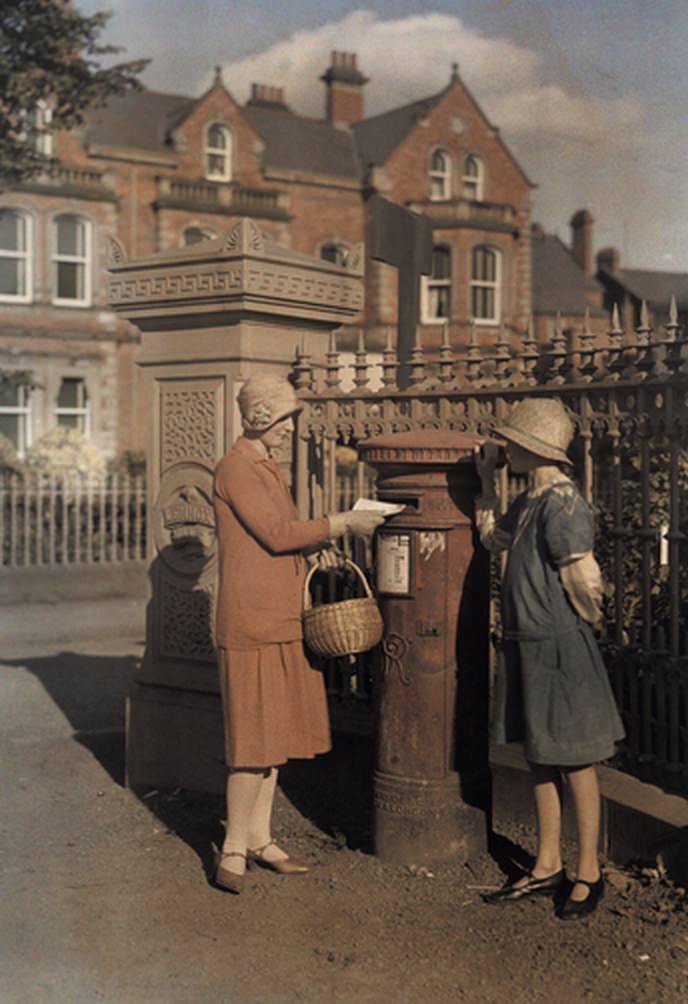
Outside a wrought-iron fence and in front of sturdy brick houses, two girls pause at a red pillar box in Belfast in 1927, turning an ordinary errand into a small moment of ritual. One holds a letter ready for posting while the other waits close by, their bodies angled toward the slot as if the next seconds matter. The street feels calm and residential, with the solid geometry of railings and masonry framing the simple act of sending news out into the city and beyond.
Warm color gives the scene an immediacy that black-and-white often mutes, letting the pillar box’s red and the muted tones of coats and hats speak for their era. Cloche-style headwear, practical shoes, and knee-length hems place these figures squarely in late-1920s everyday fashion, where neat silhouettes and layered textures ruled the street. Details like a woven basket and tidy gloves hint at daily routines—shopping, errands, correspondence—woven into the fabric of urban life.
Belfast’s pillar boxes were more than street furniture; they were dependable points of connection, turning private words into public movement through the postal system. The photo lingers on that threshold between home and world, where a message leaves a hand and enters a wider network of routes and relationships. For readers interested in 1920s Belfast, Irish social history, and women’s fashion and culture, this image offers a grounded, human-scale glimpse of how modern life was practiced one letter at a time.