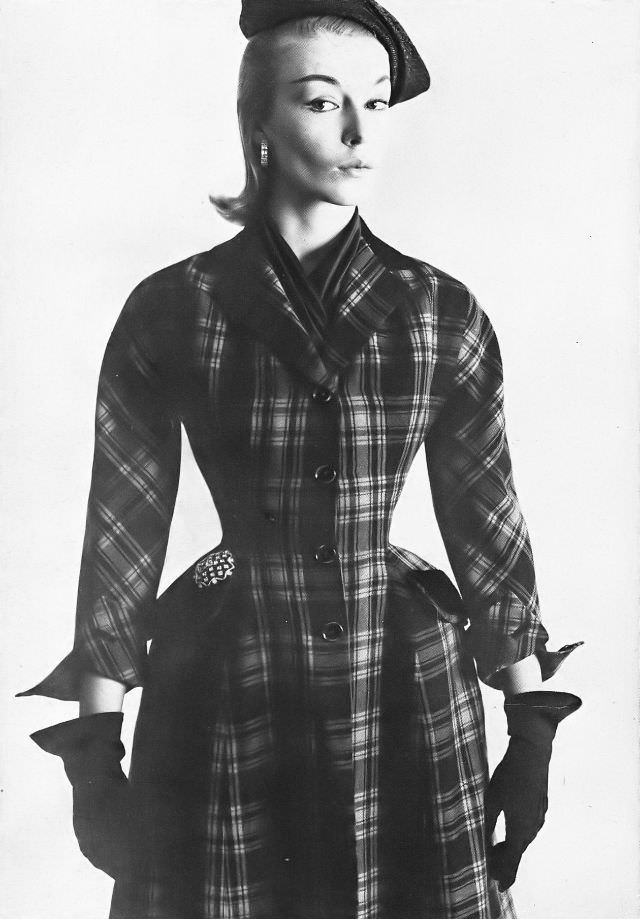
Liz Pringle stands with a poised, almost sculptural stillness, letting the tailoring do much of the talking. The fitted plaid coat—described as red-and-black wool by Christian Dior–New York—buttons cleanly down the front and cinches the waist in the unmistakable postwar silhouette, while dark gloves and a neat pair of earrings sharpen the look with evening polish. Her side-swing black straw hat tilts with quiet confidence, framing a composed expression that feels both editorial and intimate.
The photograph’s studio simplicity makes the textures feel vivid: the crisp plaid grid across the bodice, the sheen of buttons, and the soft contrast of accessories against the coat’s pattern. Even in black and white, the title’s color cues invite the viewer to imagine the richness of the wool and the dramatic interplay of red and black. A decorative accent at the hip—suggestive of a brooch or jeweled detail—adds a small flash of ornament to an otherwise disciplined design.
Fashion history often turns on moments like this, when couture sensibility is translated for a city clientele, and February 1952 sits firmly within that era of refined, waist-emphasizing elegance. The styling balances restraint and flair: practical warmth rendered glamorous, daywear elevated to high fashion through cut, proportion, and attitude. As a piece of mid-century fashion photography, it serves as a crisp record of Christian Dior–New York’s look and the model’s role in selling modern sophistication to the postwar imagination.