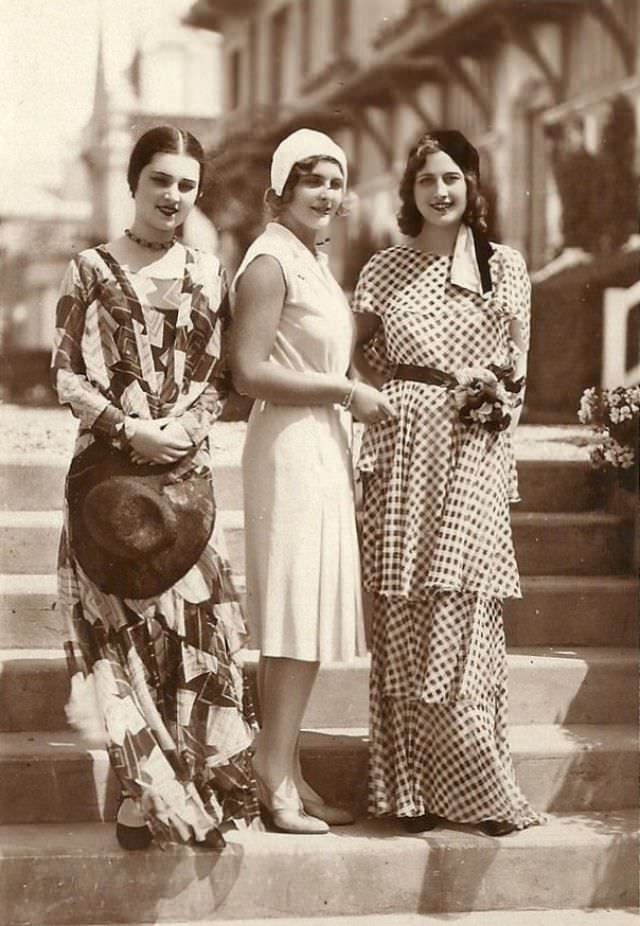
Three young beauty-pageant contenders pause together in Paris, presented in the title as Misses Russia, Austria, and Holland, and the scene has the relaxed confidence of an international visit. They stand on broad steps with a busy urban backdrop softened by shallow focus, while a hint of a spire in the distance and the street-side architecture lend a distinctly European atmosphere. Their expressions are poised and friendly, suggesting a moment staged for the press yet still personal enough to feel like a shared memory.
Fashion does most of the storytelling: one wears a boldly patterned long dress and holds a wide-brimmed hat like a prop from a summer promenade, another appears in a sleeveless light dress with a close-fitting cloche-style headpiece, and the third favors a checked dress with a sash-like belt and matching head covering. The cuts are streamlined and modern, balancing elegance with ease, and small details—necklace, gloves, and carefully arranged hair—signal how closely beauty culture and couture were intertwined. Together, the trio becomes a snapshot of 1930s style, when graphic prints and practical silhouettes met the glamour of public appearances.
Paris, long marketed as a capital of fashion and spectacle, makes a fitting stage for “Miss Europe” imagery and the era’s fascination with cosmopolitan femininity. Photos like this circulated as cultural shorthand: national titles gathered in one frame, differences expressed through dress and posture rather than flags, and modern womanhood framed as both glamorous and approachable. For readers searching vintage beauty queens, 1930s fashion, or Miss Europe Paris photographs, the image offers a vivid slice of interwar popular culture—where pageantry, travel, and style converged on the city steps.