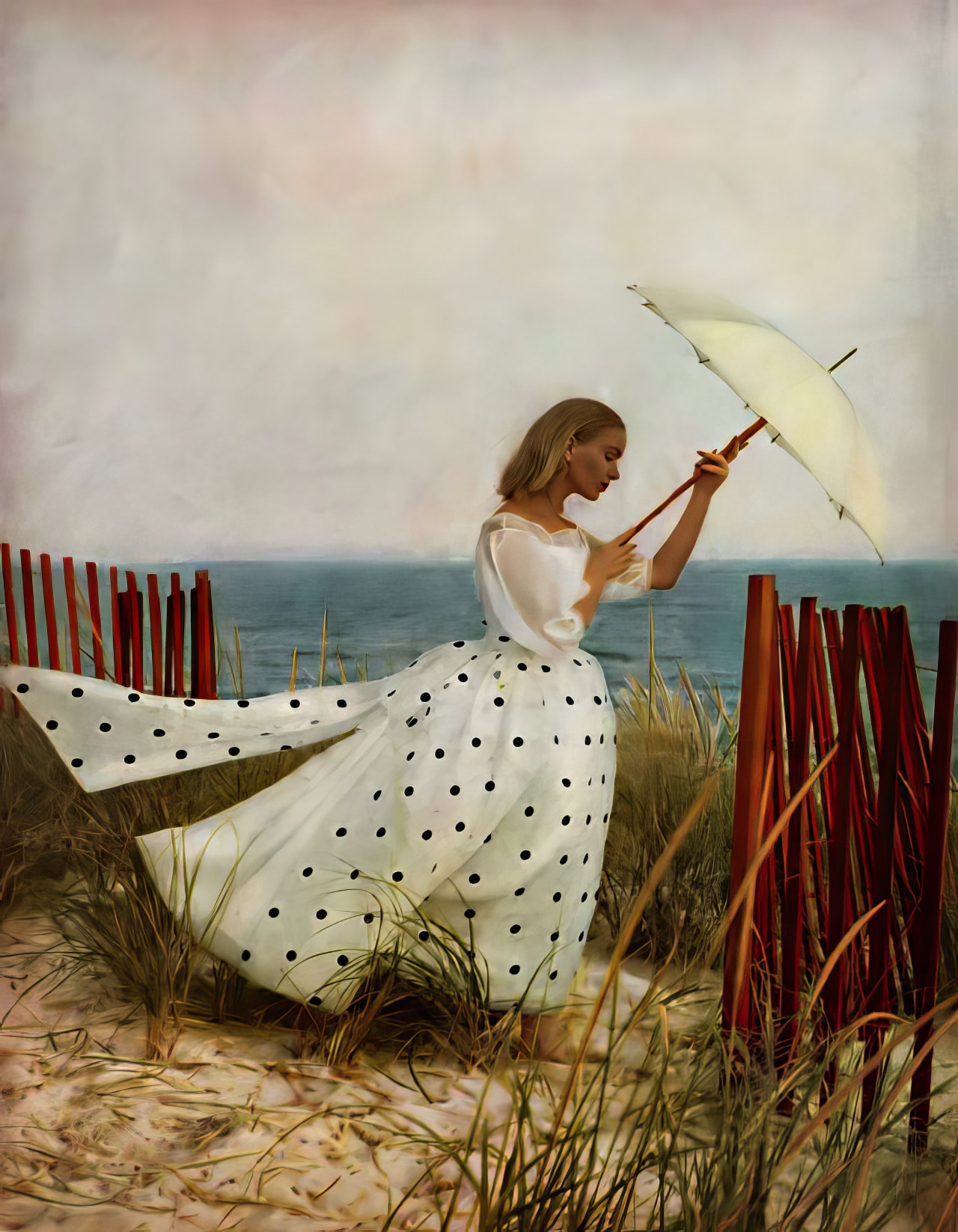
Against a pale winter sky and a calm band of ocean, a fashion model moves through beach grass with the poise of a magazine heroine. She lifts a white umbrella as if bracing for a coastal gust, while her long, billowy skirt streams behind her like a sail. Slender red sand fences punctuate the dunes, their vertical lines heightening the sense of motion and framing the scene with a distinctly mid-century rhythm.
Jack Horwitz’s white organdy dress, featured in Harper’s Bazaar U.S. for December 1956, turns lightness into structure: a sheer, softly fitted bodice gives way to a voluminous skirt scattered with bold polka dots. The airy fabric catches and releases the breeze, suggesting both comfort and drama, while the clean palette—white, black, and the warm red of the fencing—keeps the styling crisp and graphic. Even without close detail, the silhouette speaks the language of 1950s couture: controlled waist, generous fullness, and an elegance designed to be seen in motion.
The photograph’s seaside setting lends this editorial a narrative beyond the studio, pairing high fashion with the everyday weather of dunes and salt air. That blend of glamour and environment—luxurious material tested by wind, a refined pose set against open water—captures the aspirational mood that made Harper’s Bazaar fashion stories so influential in postwar American culture. As a piece of 1956 fashion history, it remains a vivid example of how editorial imagery transformed a dress into a cinematic moment.