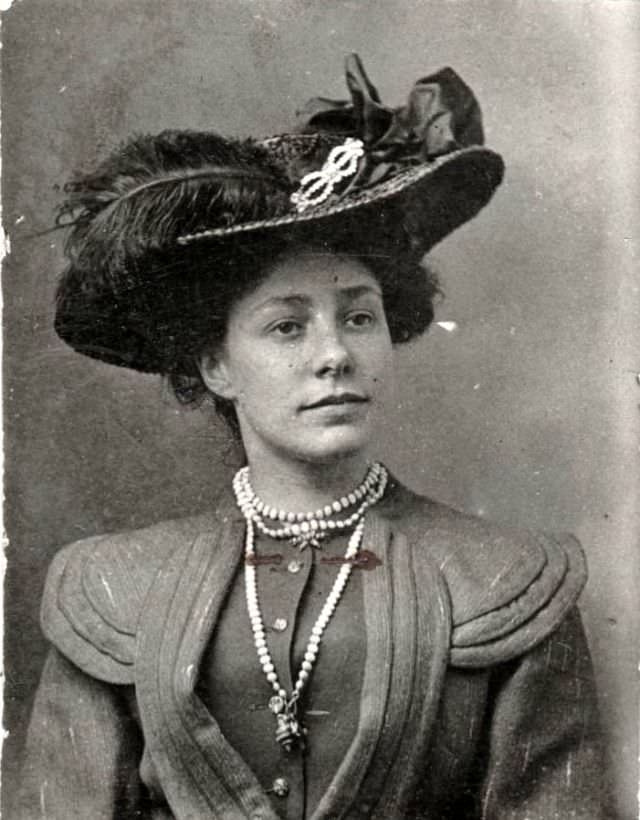
Poised beneath a sweeping Edwardian hat, the sitter wears her fashion like a declaration. The brim curves outward in a broad arc, built up with dark feathers and finished with a bold bow and a small ornamental detail that catches the light. Her steady, direct gaze is framed by the dramatic silhouette above, a reminder that women’s hats in the early 1900s were designed to be noticed from across a room.
Equally telling are the carefully chosen accessories and tailoring that complete the look. A long strand of pearls and a shorter necklace rest over a high-buttoned bodice, while a fitted jacket with structured, padded shoulders creates the strong, sculpted line favored in Edwardian women’s dress. The overall effect balances softness and authority—luxury materials, meticulous construction, and a confident posture working together to signal respectability and style.
Such portraits explain why Edwardian era hats became cultural shorthand for status, modernity, and the rituals of public life. Millinery was not merely decoration; it was a language of feathers, ribbon, and brim width that spoke to taste, aspiration, and the era’s fascination with spectacle. For anyone searching women’s fashion history, Edwardian hat styles, or early 20th-century portrait photography, this image offers a crisp window into how an accessory could define an entire silhouette—and, by extension, an entire moment in time.