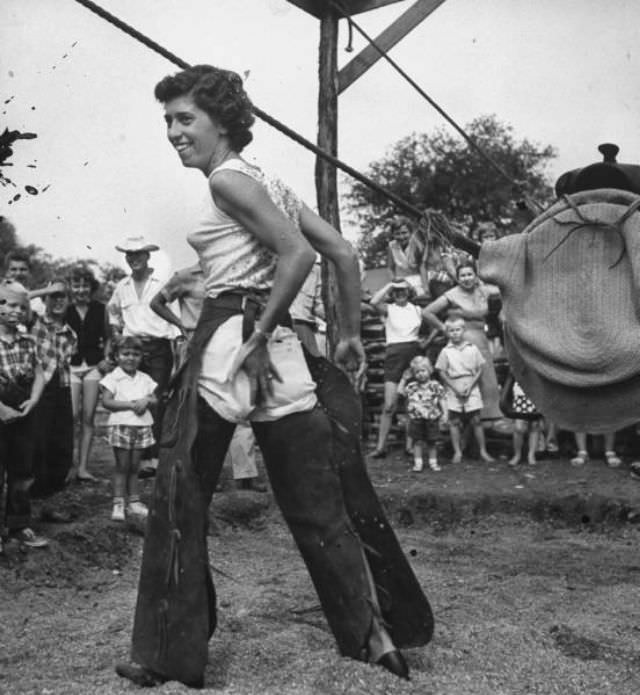
Sunlight and dust frame a candid moment at what feels like a community rodeo or outdoor exhibition, where a young woman steps confidently near a saddled horse as spectators cluster behind a rope line. The scene has the easy bustle of a fair day—children in front, adults leaning in for a better look, and that unmistakable sense that something lively is underway. Rather than a studio pose, the photograph offers a glimpse of everyday performance and participation, the kind of local entertainment that shaped American Western culture far beyond movie sets.
Her outfit speaks volumes about 1940s cowgirl fashion and the realities of movement: wide-leg trousers for practicality, sturdy footwear, and a sleeveless top that reads as both modern and work-ready. A scarf or jacket tied at the waist hints at changing temperatures and long hours outdoors, while the horse’s tack and saddle anchor the image firmly in equestrian life. It’s a reminder that “cowgirl” style often blended utility with flair—clothes made to ride, handle animals, and still look sharp in a crowd.
Beyond the Silver Screen, the authentic life of the 1940s American cowgirl comes into focus as a mix of skill, community, and culture—part sport, part labor, and part social stage. These gatherings were where Western identity was performed and negotiated in real time, with women claiming space through competence and presence as much as through costume. For readers searching for 1940s cowgirl fashion, vintage Western culture, or the history behind rodeo-era style, this image offers a grounded, human snapshot of how the look was lived.