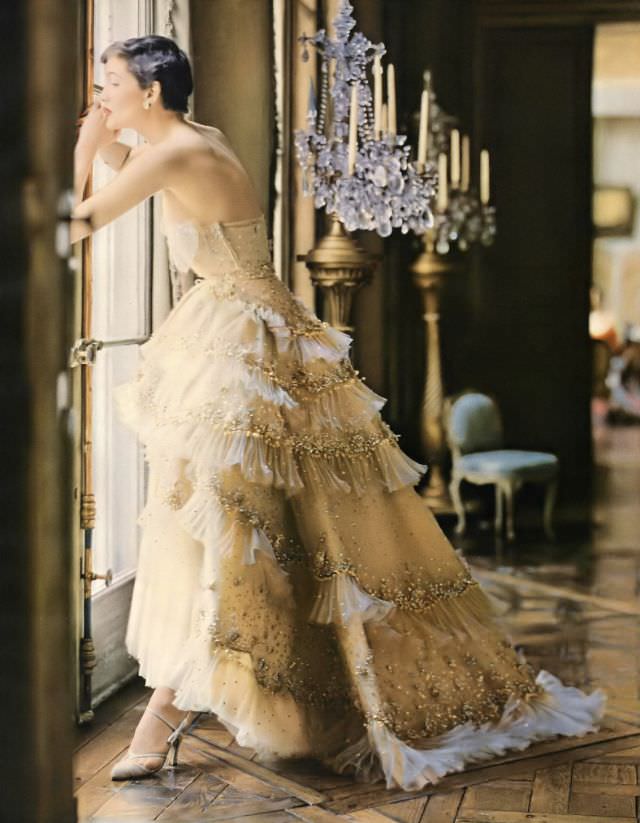
Leaning toward a tall window, Maxime de la Falaise appears poised between private reverie and public spectacle, her profile turned to the light as if listening for something beyond the glass. The setting feels palatial—polished parquet underfoot, a crystal chandelier suspended like a frozen burst of music, and the muted depth of a grand interior receding behind her. Even without a crowd in view, the moment carries the hush of an evening about to begin.
Christian Dior’s gown “Mozart” is all movement and ornament, a strapless bodice flowing into tiered ruffles that tumble down the skirt in airy cascades. Glittering embroidery and beaded embellishments catch the light along each horizontal band, giving the dress a shimmering rhythm, while the long train softens into the floor like a final flourish. The silhouette speaks unmistakably to mid-century haute couture: romantic volume, meticulous handwork, and a theatrical elegance designed for formal rooms and candlelit entrances.
Fashion photography of this era often staged women as modern heroines in aristocratic spaces, and this image plays that story with subtlety rather than bravado. De la Falaise’s sleek, short hairstyle and delicate evening shoes sharpen the look’s modern edge, balancing the gown’s opulence with restraint. For anyone searching 1950 Dior couture, Maxime de la Falaise style, or the golden-age glamour of postwar Paris fashion, the photograph offers a vivid, timeless portrait of luxury and culture in perfect accord.