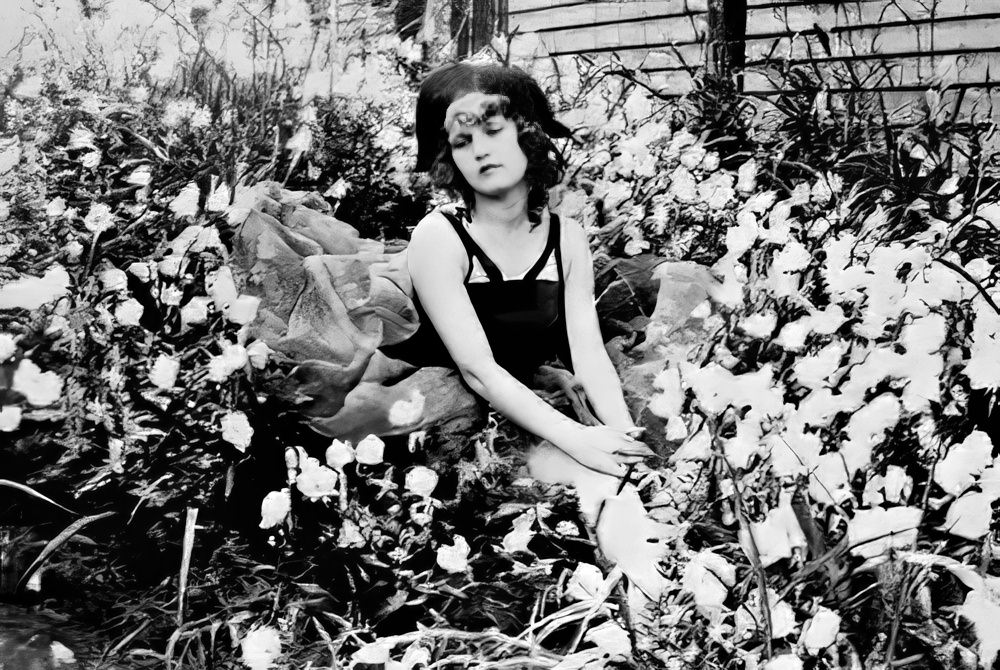
Soft light and dense blossoms frame a young woman posed among garden plants, her bobbed hair and headband echoing the flapper style that came to define 1920s fashion. A dark, strappy dress contrasts with the pale petals around her, creating a staged, almost theatrical composition where modern glamour meets nature’s abundance. Behind her, the plain lines of a wooden wall keep the focus on the figure and the riot of flowers in the foreground.
Zelda Fitzgerald, remembered as an author and as the wife of F. Scott Fitzgerald, has often been pictured at the intersection of artistry, celebrity, and rebellion. Here, her downward gaze and relaxed posture suggest a quieter mood than the era’s jazz-age caricatures, offering a more intimate look at a woman who inspired—and challenged—the cultural imagination around her. The photograph leans into the period’s fascination with performance and persona, while still leaving room for ambiguity.
Garden imagery like this also served as a visual metaphor in early 20th-century portraiture, linking youth, beauty, and modern femininity to cultivated spaces. For readers searching Jazz Age icons, flapper aesthetics, and Zelda Fitzgerald photographs, the scene captures the visual language of the time: short hair, streamlined dress, and a carefully arranged setting that feels both spontaneous and composed. It’s an enduring glimpse of 1920s culture, where style and self-invention were treated as an art form.