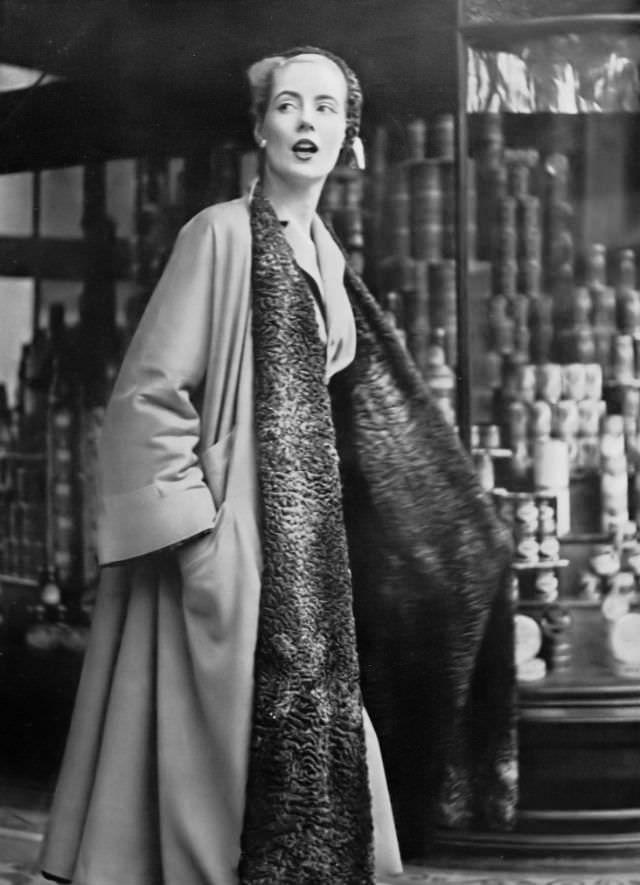
Pat O’Reilly steps into view with the poised, slightly theatrical confidence that defined early-1950s fashion editorials, her gaze turned as if caught mid-conversation on a city street. The reversible coat by Bradleys hangs with generous, sculptural ease, its broad sleeves and clean outer surface framing a darker, richly textured lining that reads like a deliberate flash of luxury. Behind her, a shopfront window stacked with merchandise becomes a lively backdrop, grounding the high-fashion styling in everyday urban bustle.
What makes the look memorable is the garment’s promise of versatility: one coat offering two moods, practical by day and more dramatic when the patterned side is revealed. The styling echoes the era’s taste for polished simplicity—neat hair, understated accessories, and a silhouette that balances fullness with control—while the coat’s movement suggests the editorial’s love of spontaneity. Even in monochrome, the contrast between smooth fabric and plush interior delivers a tactile story that would have appealed to Harper’s Bazaar UK readers.
Dated to November 1951, the photograph serves as a small time capsule of postwar style aspirations, when smart outerwear signaled modernity, mobility, and confidence. It also highlights how fashion magazines used street-like settings to make couture-minded pieces feel attainable, inviting viewers to imagine themselves stepping out in the same commanding layers. For collectors and researchers of 1950s fashion, Bradleys outerwear, and Harper’s Bazaar UK photography, this image offers a crisp example of period silhouette, texture play, and editorial storytelling.