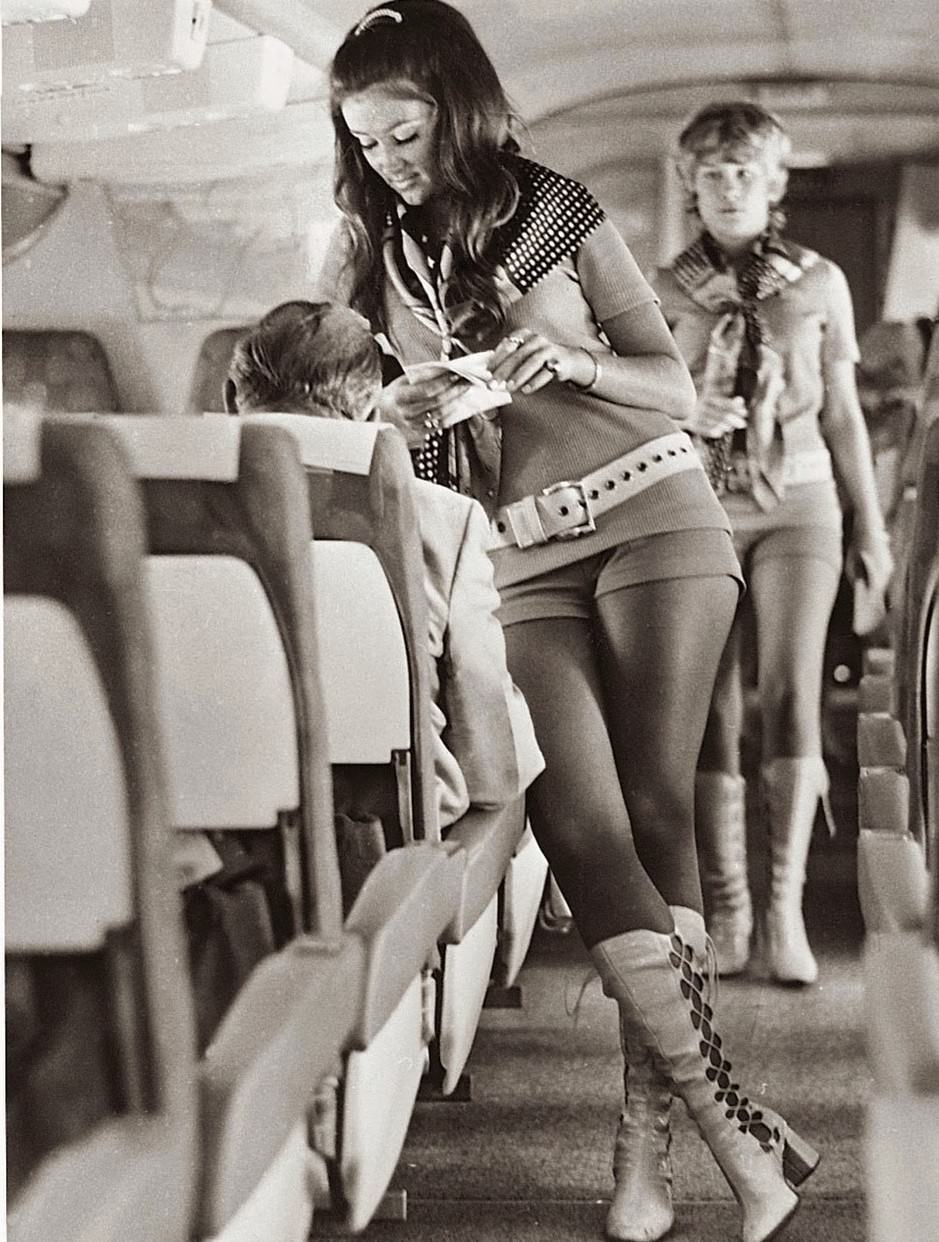
Down the narrow aisle of a commercial jet, a flight attendant leans toward a seated passenger, mid-service, her posture relaxed and practiced. The uniform is unmistakably of its era: short hot pants, a wide statement belt, patterned neck scarf, and tall lace-up boots that read more like nightlife fashion than the conservative tailoring that once defined airline professionalism. Another attendant appears in the background in a similar look, reinforcing that this was not a one-off novelty but a coordinated brand image carried through the cabin.
Airline style had long been sold as reassurance—crisp hats, modest hems, and the promise of order at 30,000 feet—yet the early 1970s brought a jolt of pop culture into the skies. Southwest Airlines’ 1973 decision to “throw caution to the winds” turned the flight attendant uniform into a marketing headline, and the title’s blunt quote from male management lays bare the gendered expectations baked into that strategy. In this photograph, the glossy, mod-inspired outfit becomes part of the airline’s pitch: youth, fun, and a wink of provocation packaged as customer service.
Seen today, the scene is a vivid artifact of how fashion, labor, and advertising overlapped in aviation history, especially as women were asked to embody a company’s image as much as its safety standards. The cabin details—tight seat rows, overhead bins, and the rhythm of aisle work—ground the glamour in the everyday realities of the job. For readers interested in flight attendant fashion, 1970s airline culture, and the evolution of workplace uniforms, this moment captures a sharp turn from propriety to spectacle that still sparks debate.