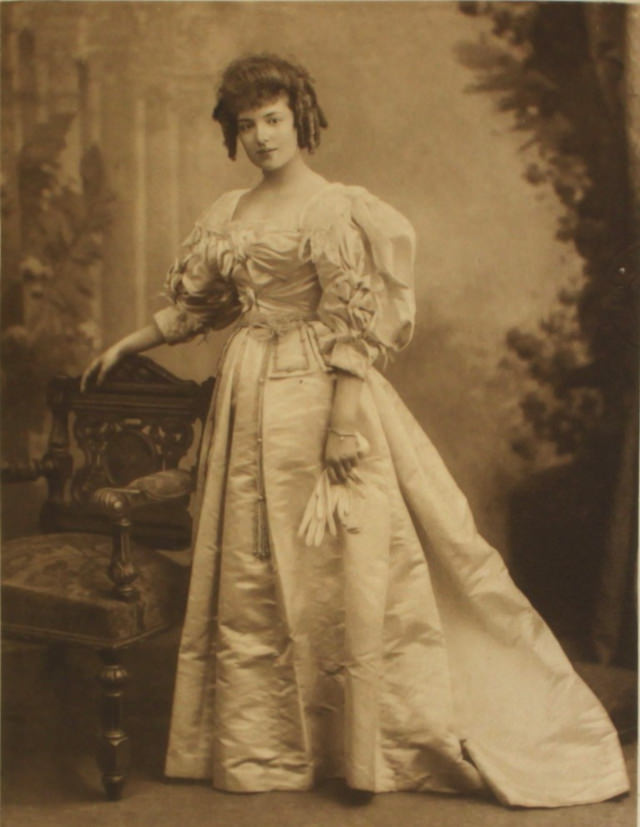
Lady Margaret Villiers stands in a poised studio portrait, one hand resting on an upholstered chair as her costume falls in luminous folds to the floor. The gown is deliberately theatrical—an ample skirt with a long, sweeping train and a fitted bodice gathered at the front—designed to read instantly as “court dress” even in the soft focus of late-Victorian photography. Dark curls frame her face, and the controlled, self-possessed stance suggests a sitter accustomed to being observed.
The title points to a clever historical echo: she is dressed as “Madame,” Duchess d’Orléans, known as the wife of “Monsieur” and the sister of Charles II, a figure associated with Restoration-era glamour and political intrigue. Whether coincidence or design, the choice turns fabric into storytelling, inviting viewers to compare Victorian fancy-dress ideals with seventeenth-century French and English court imagery. Details like voluminous sleeves, the structured waist, and the careful drape of the overskirt reinforce the pageantry that such an impersonation required.
Linked to the celebrated 1897 Devonshire House Ball, the photograph belongs to a moment when elite costume events became showcases of historical fashion, social status, and meticulous craftsmanship. The painted backdrop and salon furniture create a genteel setting that complements the character she embodies, while the satin sheen and tailored silhouette highlight the era’s fascination with reenacting aristocratic pasts. For readers interested in the Devonshire House Ball costumes, Victorian society portraits, and the intersection of fashion and culture, this image offers a vivid glimpse of how history was worn—quite literally—for a night.