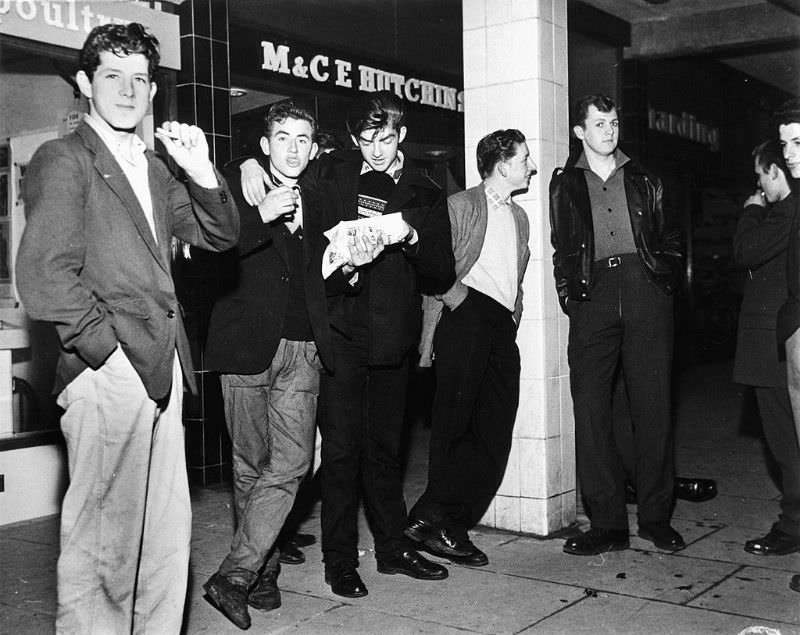
Outside the fish and chip shop in Newtown Aycliffe, a loose circle of youths turns the pavement into an evening headquarters, as familiar and important as any club. The shopfront signage and glossy tiled pillars frame a scene of casual belonging: shoulders touch, hands gesture mid-conversation, and one lad cradles a wrapped meal as if it were the night’s centerpiece. The camera catches them at ease, half performing for the lens and half ignoring it, the everyday rhythm of a new town finding its social heart.
Sharp jackets, narrow ties, slicked hair, and confident stances place the moment firmly in late-1950s British youth culture, when style was a declaration as much as a choice. Some lean back against the wall in fitted trousers and polished shoes; another stands slightly apart, cigarette poised, watching the street like it’s his stage. The fish-and-chip shop becomes more than a takeaway here—an affordable meeting place where friendships are made, rivalries smoothed over, and Saturday-night plans negotiated.
Dated October 1959 in County Durham, the photograph doubles as a small document of postwar community life in a planned “new town,” where public squares and shops were built to serve growing estates. In such settings, bright storefronts and shared routines helped turn new streets into a lived-in neighbourhood, and young people claimed these corners as their own. For anyone searching for Newtown Aycliffe history, 1950s street fashion, or the social role of the British chip shop, this image offers a vivid, grounded glimpse of how modern Britain was being assembled—one gathering spot at a time.