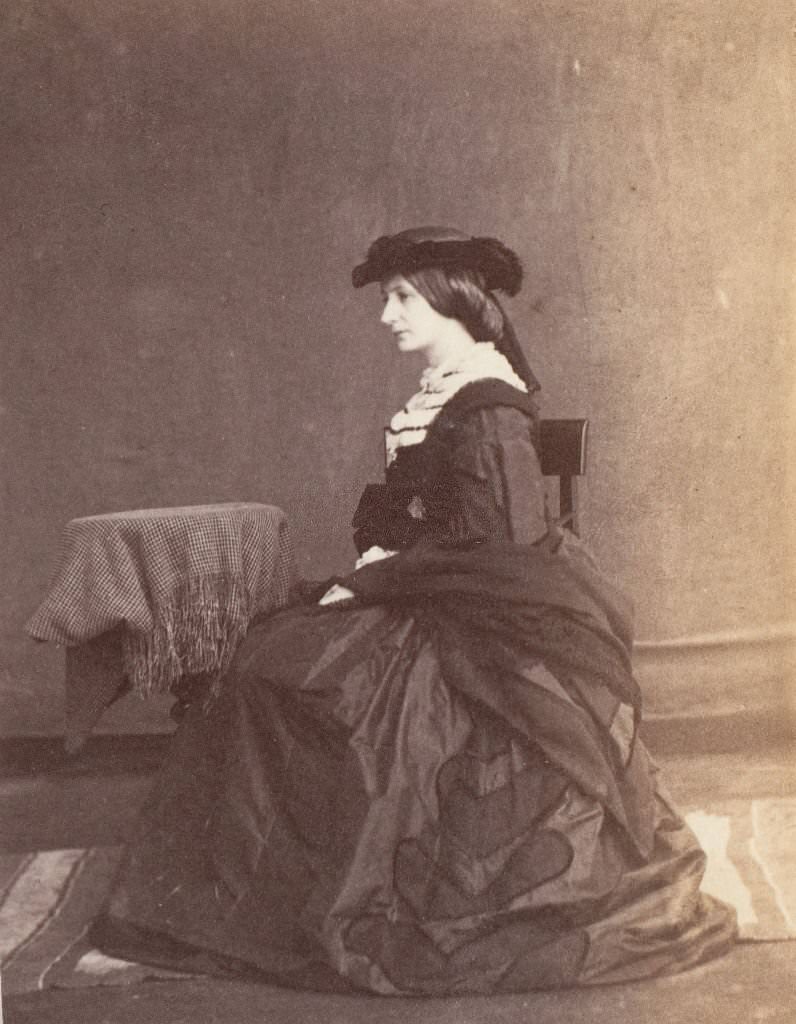
Seated in profile, Lady Campbell appears as a composed figure of mid-19th-century fashion, her gaze turned slightly away as if caught in a quiet moment of thought. A dark bonnet frames her face, while a pale, layered collar draws the eye to the bodice and the careful finishing at the neckline. The restrained studio backdrop keeps attention on her posture and dress, a portrait style typical of formal Victorian photography.
The crinoline-supported skirt dominates the scene, spreading outward in structured volume and emphasizing the era’s distinctive silhouette. Heavy fabric and broad panels fall in deliberate folds, revealing the engineering of understructures as much as the artistry of tailoring. Even the simple chair and the small table draped in patterned cloth serve to scale the gown’s breadth, underscoring how fashion shaped not only appearance but also the way women occupied space.
Dated 1861 in the title, the portrait offers a vivid reference point for researchers and enthusiasts of Victorian dress, women’s history, and 19th-century cultural life. Details like the bonnet, the contrasting collar, and the expansive crinoline make it especially valuable for those searching for period-accurate inspiration in costume design, genealogy collections, or fashion history archives. Beyond the garments, the image conveys a social language of poise and presentation—an intimate glimpse into how identity was staged in the early age of the photographic studio.