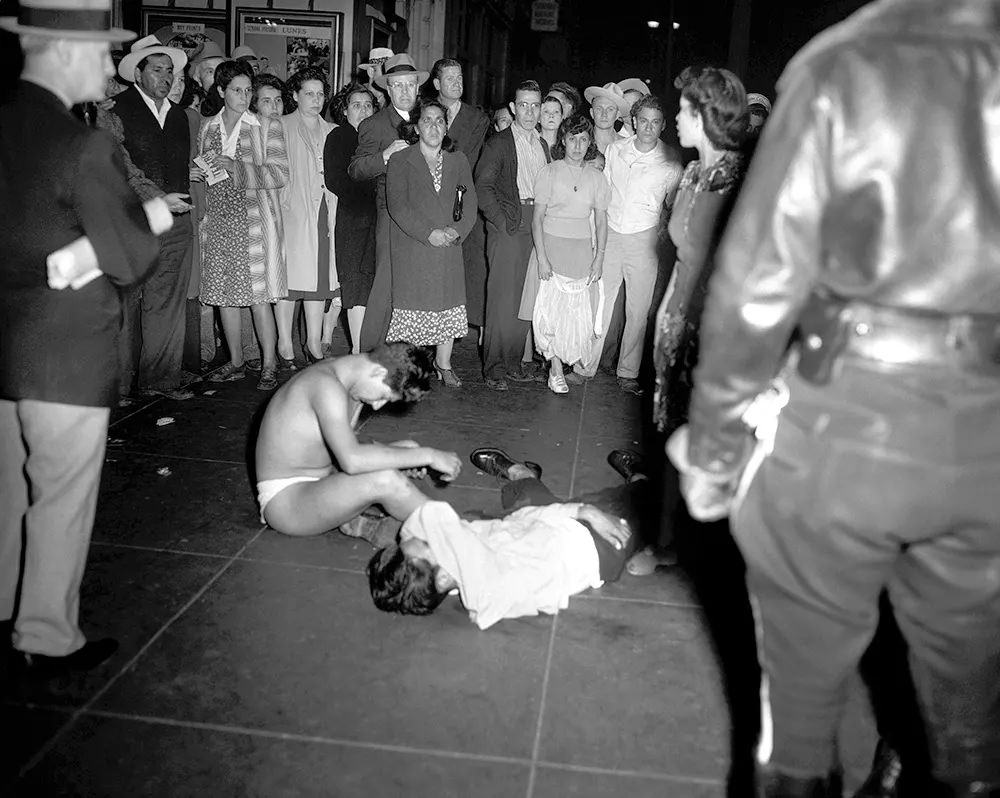
Under the harsh glare of street lighting, two battered teenagers lie on a sidewalk as a tight ring of onlookers presses in, their faces fixed with shock, curiosity, and unease. One youth sits hunched and half-undressed, head bowed as if trying to gather himself, while another sprawls nearby amid scattered clothing. The crowd—men in hats, women in dresses, and uniformed figures at the edges—turns the pavement into an impromptu stage where violence has already done its work.
At the center of the frame, the contrast between youth and authority is unmistakable, reflecting the volatile atmosphere suggested by the title: teenagers stripped and beaten by U.S. Navy sailors. Uniforms and civilian coats blur together in the periphery, hinting at how quickly group aggression can become public spectacle when a street fills with witnesses. Even without visible blows, the aftermath—exposed skin, discarded garments, and cramped bodies on the ground—speaks to humiliation as much as injury.
Fashion and culture sit just beneath the surface of this scene, echoing the broader tensions associated with the Zoot Suit Riots and the way style could be treated as provocation. The photo’s power lies in its crowded stillness: no single expression offers resolution, only a collective pause after chaos. For readers searching the history of wartime unrest, youth subcultures, and public violence in American cities, this image stands as a stark reminder of how quickly prejudice and panic can spill into the open.