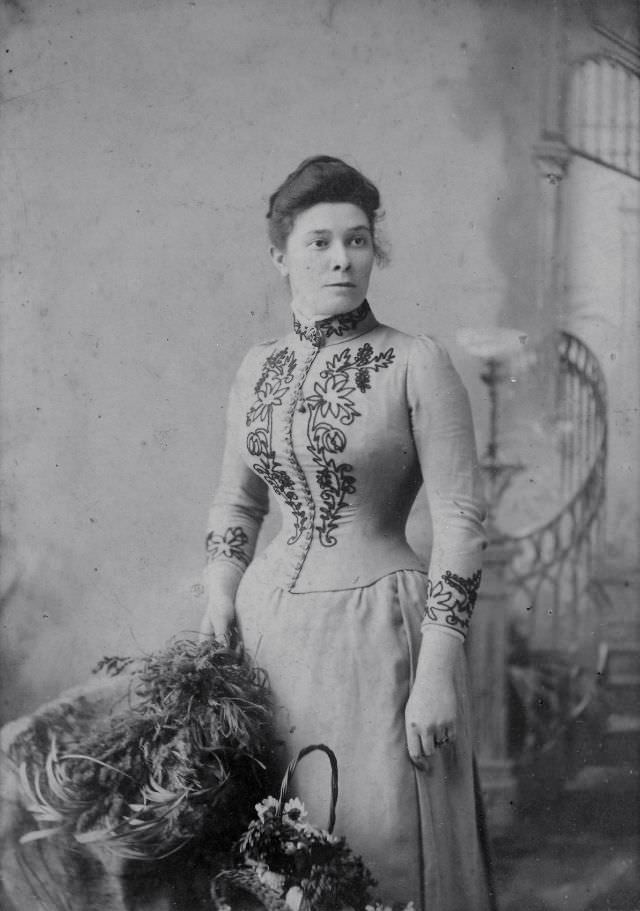
Poised beside a studio backdrop, a Victorian woman turns her head slightly as if interrupted mid-thought, her expression composed and self-possessed. The silhouette is unmistakably late 19th century: a tightly fitted bodice emphasizing a narrow waist, balanced by a long skirt that falls in clean lines. Embroidered floral motifs climb the front and cuffs, drawing the eye to the structured torso where the corset’s shaping power is felt even when it remains hidden.
Corsets were more than a fashionable undergarment in Victorian-era dress; they were engineering, etiquette, and social expectation stitched into one. The smooth, disciplined line of the torso—supported by boning and careful lacing—was designed to make outer garments sit correctly, especially high collars and tailored bodices like this one. Details such as the high neckline and decorative trimming reflect how women’s fashion blended modest coverage with elaborate surface ornament, using texture and pattern to signal refinement.
In the foreground, a large arrangement of feathers or dried fronds and a basket of flowers lend the scene a carefully arranged, domestic elegance typical of period portrait photography. A faint glimpse of a staircase and railing in the background suggests a staged interior meant to evoke respectability and comfort, even when photographed in a studio setting. As a piece of fashion history, the image speaks to the late Victorian fascination with the “ideal” figure—and to the everyday realities of dressing, posture, and presentation shaped by the indispensable corset.