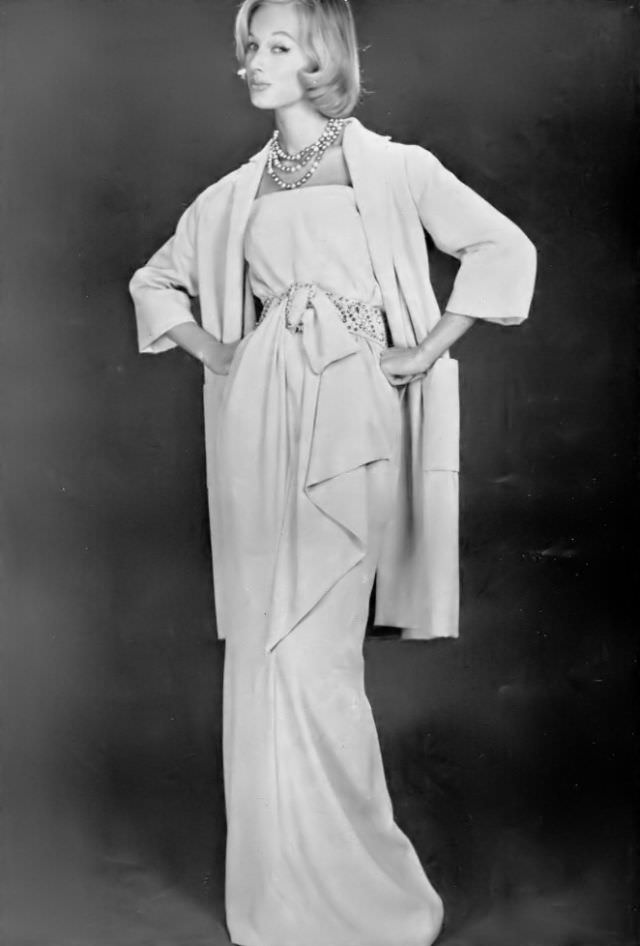
Monique Chevalier stands in poised profile, hands set at the waist as if to underline the architecture of the look. The 1957 Madeleine de Rauch evening ensemble in crêpe falls in a long, fluid column, its soft drape broken by a sculpted, cascading panel that creates movement without sacrificing restraint. Against a plain studio backdrop, the silhouette reads clearly: elegant, elongated, and unmistakably mid-century in its controlled glamour.
A light-toned coat is worn open over the strapless gown, adding a polished layer that suggests arrival and departure—fashion designed for an evening’s full narrative, not just the ballroom moment. The waist is cinched with a sparkling belt or jeweled sash, a concentrated point of brilliance that contrasts with the matte smoothness of crêpe. Multiple strands of pearls at the neck echo the era’s love of refined accessories, framing the face and balancing the clean lines of the bodice.
Seen today, the photograph functions as both fashion documentation and cultural artifact, capturing how couture-style eveningwear translated modern femininity into fabric and proportion. The styling favors simplicity—no busy set, no props—so the eye lingers on texture, drape, and the confident attitude of the model. For anyone searching 1950s fashion, Madeleine de Rauch designs, or classic evening gown inspiration, this image offers a crisp lesson in understated luxury and Paris-ready sophistication.