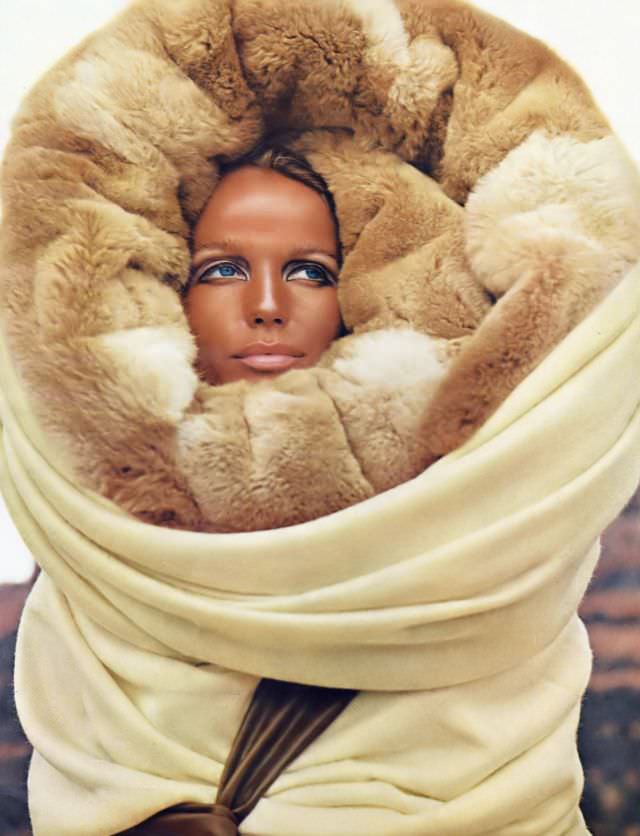
Wrapped in a monumental collar of fur and soft jersey, Veruschka’s face appears like a mirage at the center of a sculptural halo. The styling turns clothing into architecture: plush, sand-toned textures swell around her head and shoulders, while a smooth sweep of fabric gathers below, suggesting both protection and drama. Her cool, steady gaze—accented by vivid blue eye makeup—anchors the composition with the poised distance that made her such a compelling presence in 1960s fashion imagery.
Giorgio di Sant’ Angelo’s design reads as desert-ready fantasy, an editorial answer to the Painted Desert’s wide horizons and shifting colors. The palette echoes sun-bleached stone and wind-worn earth, making the outfit feel inseparable from the landscape even when the background falls away into blur. That tension—between rugged American Southwest and high-fashion refinement—gives the photograph its unmistakable Vogue energy: escapist, modern, and intensely graphic.
Published in Vogue in 1968, the image sits at the crossroads of fashion and cultural mood, when magazines embraced bold silhouettes and cinematic styling to match a changing decade. The tight framing isolates form and texture, turning fur, jersey, and skin into a study of surfaces, while the model’s nearly immobile pose heightens the sense of enigma. For searchers of Veruschka editorials, Giorgio di Sant’ Angelo designs, or Painted Desert Arizona fashion photography, this remains an iconic example of how the period transformed garments into storytelling.