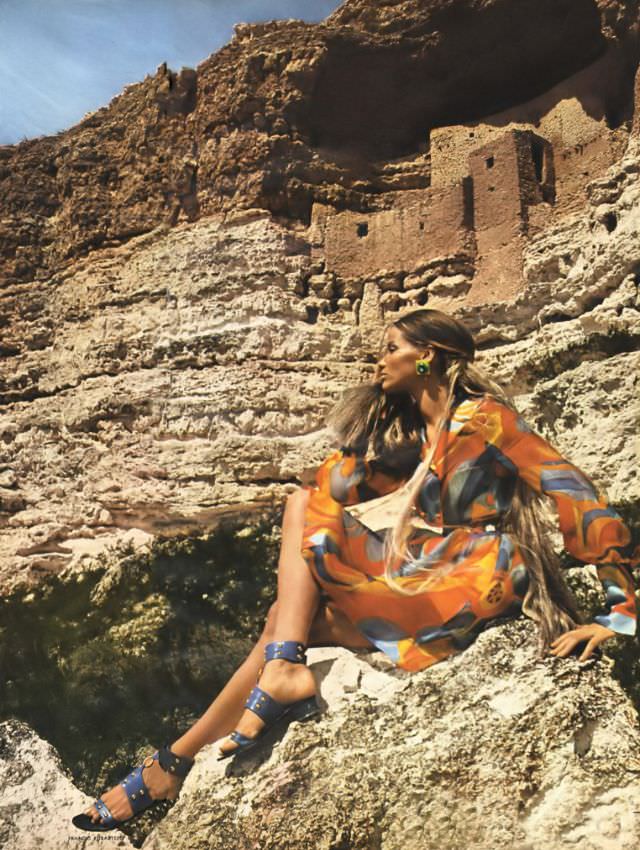
Sunlit rock faces rise behind Veruschka like a natural stage, their pale layers and weathered ruins lending the fashion story an almost archaeological grandeur. Set against that rugged backdrop, the silk organza dress by Harold Levine reads as pure movement—diaphanous yet vivid, its swirling pattern catching the light and echoing the striations of the cliff. The pose is statuesque but unforced, a moment of stillness that makes the surrounding landscape feel even more immense.
Veruschka’s profile, turned away from the viewer, heightens the sense of mystery that Vogue leaned into during the late 1960s, when models were styled as characters rather than mannequins. Long hair falls over her shoulder, bold earrings punctuate the look, and strappy sandals in a saturated tone anchor the airy fabric to the ground. The overall styling plays on contrast: delicate organza against stone, high fashion against an ancient, crumbling structure, glamour framed by raw terrain.
Fashion & culture meet here in a way that remains instantly searchable and recognizable to fans of iconic Vogue editorials—an outdoor shoot that treats the environment as a collaborator rather than a backdrop. The photograph’s warm palette and expansive composition turn a garment into a narrative about escape, modernity, and the era’s appetite for far-flung settings. More than a dress moment, it’s a 1968 snapshot of how magazine fashion learned to speak in cinematic, elemental images.