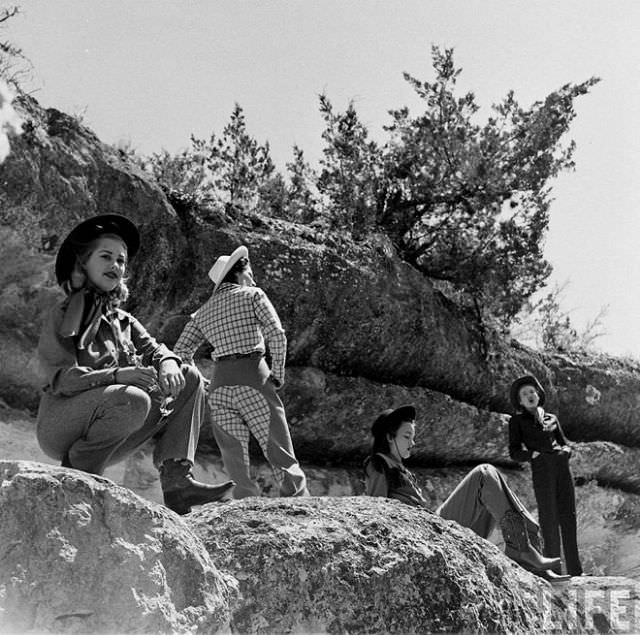
Sunlight falls hard across a rocky hillside where four women pause mid-outing, their Western-inspired outfits reading as both practical and proudly styled. Wide-brim hats and neck scarves frame their faces against the scrubby trees, while high-waisted trousers and fitted tops echo the clean, confident lines associated with 1940s cowgirl fashion. The setting feels far from a studio set, lending the scene an everyday immediacy that fits the post’s promise to look beyond the silver screen.
Clothing details do much of the storytelling here: tailored pants that allow easy movement over uneven ground, sturdy shoes, and accessories that balance utility with flair. Even in black and white, the contrast of patterned fabric against solid tones suggests careful coordination rather than costume, hinting at how Western wear filtered into leisure life, travel, and outdoor recreation. Their relaxed poses—one seated, another standing with her back turned, others resting on the rocks—add to the sense of real women inhabiting a cultural moment, not performing a role.
Fashion and culture intertwine in images like this, where the “cowgirl” look becomes a language of independence, modernity, and regional identity during the 1940s. For readers interested in vintage Western style, wartime-era American trends, and the evolution of women’s outdoor dress, the photograph offers a textured snapshot: rugged landscape, self-assured silhouettes, and the subtle glamour of everyday Americana. It’s a reminder that authenticity often lives in small choices—how a scarf is tied, how a hat is worn, and how comfortably a person carries what she’s put on.