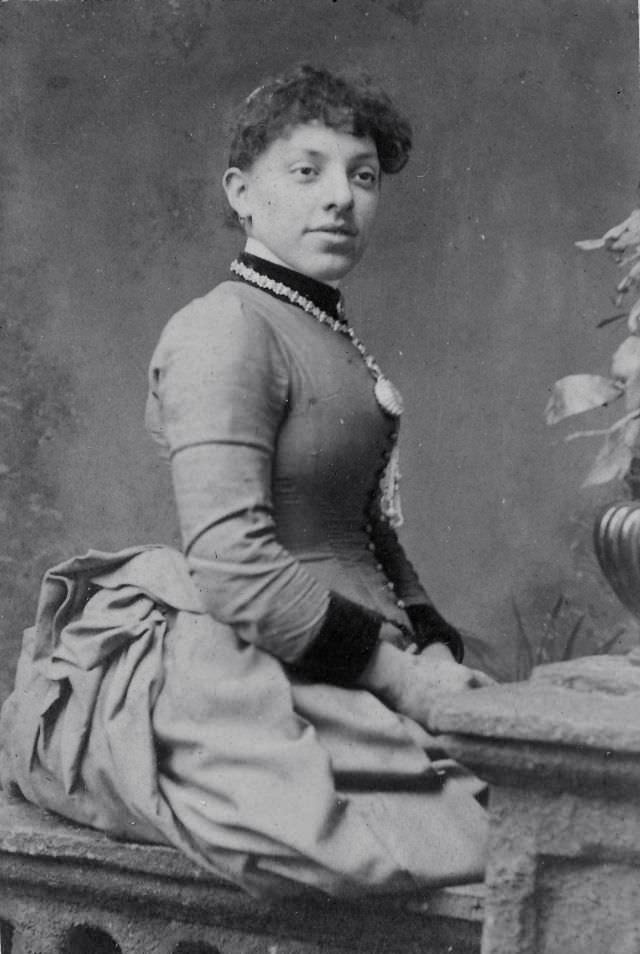
Poised in a studio setting, a Victorian-era woman sits in profile with her gaze turned toward the camera, her posture straightened by the era’s most essential foundation garment: the corset. The fitted bodice pulls the waist into a pronounced curve while emphasizing the structured line of the torso, a silhouette prized in late 19th-century fashion. Soft light and a plain backdrop keep attention on the carefully arranged clothing and the self-possessed expression that meets the viewer.
Her dress layers tell a story of technique as much as taste—smooth, closely tailored fabric across the chest and midsection, darker cuffs at the wrists, and a high neckline that frames the face. Decorative trim and a small pendant-like detail at the throat add refinement without competing with the garment’s architecture. Behind her, the bustle-like drape of fabric at the back hints at the engineered volume Victorian women wore, balancing a narrow waist with fullness and sweep.
Corsets were more than a trend; they were an indispensable undergarment shaping how outerwear sat, how the body was presented, and how femininity was publicly read in Victorian society. Photographs like this one offer a rare, intimate look at the tension between comfort and convention, beauty and discipline, as clothing literally molded the fashionable form. For anyone exploring Victorian women’s fashion, tight corsets, and 19th-century culture, the image stands as a vivid record of style built on structure.