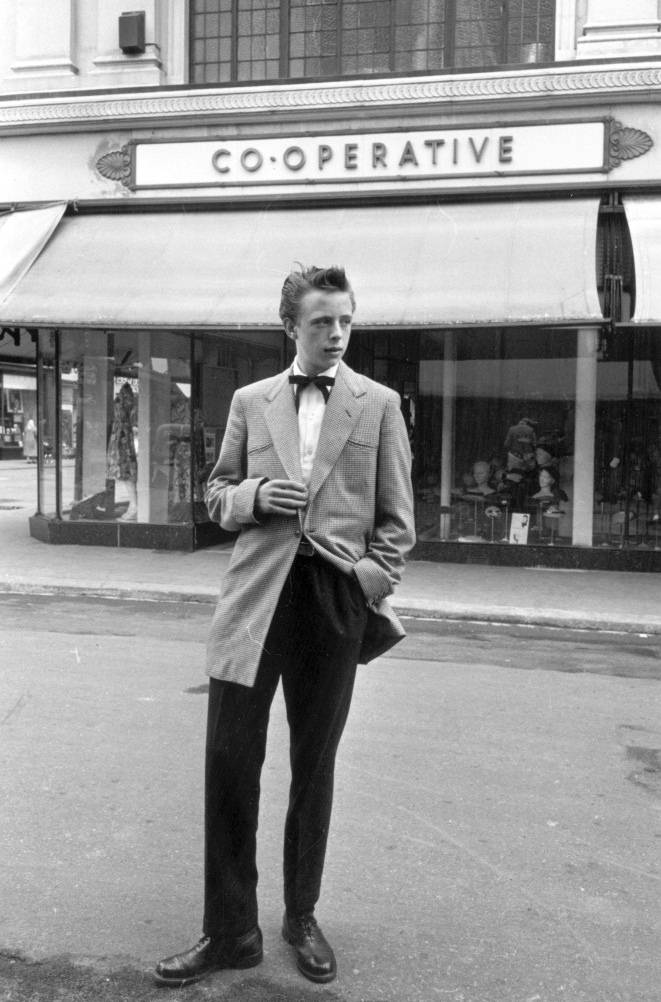
Under the bold “CO-OPERATIVE” sign, a young man stands in Tottenham, North London, caught in the confident pose of post-war youth culture: one hand in his pocket, the other tugging at the front of a long, tailored overcoat. His hair is sculpted into a high quiff and his outfit—sharp jacket, neat bow tie, and wide-legged trousers—signals the unmistakable silhouette associated with Teddy Boy style in 1950s Britain. Behind him, the shopfront windows and awning of the local Co-op anchor the scene in everyday high-street life, where fashion statements were made on ordinary pavements.
The composition balances street swagger with suburban routine, a reminder that style movements didn’t belong only to dance halls and city centres. Reflections and displays in the Co-op windows hint at the bustle of local commerce, while the subject’s sideways glance suggests motion just beyond the frame—mates, passers-by, or the photographer’s direction. For anyone searching for authentic vintage London street photography, this Picture Post moment reads like a small chapter of social history: youth identity, consumer spaces, and the performative confidence of a generation coming of age.
Known from the publication’s caption as Frank Harvey, he would later run a pet shop called “Alan’s Pet Supplies” at 75 Silver Street in nearby Edmonton, and family memory holds that this very photograph was kept behind the counter. That detail turns a magazine image into a personal relic, linking a 1954 snapshot of fashion and attitude to the long, working rhythm of a local business. In that sense, the picture functions both as a classic record of 1950s Teddy Boy culture and as a tangible thread connecting Tottenham’s Co-op frontage to the later story of a shopkeeper proud of his youthful style.