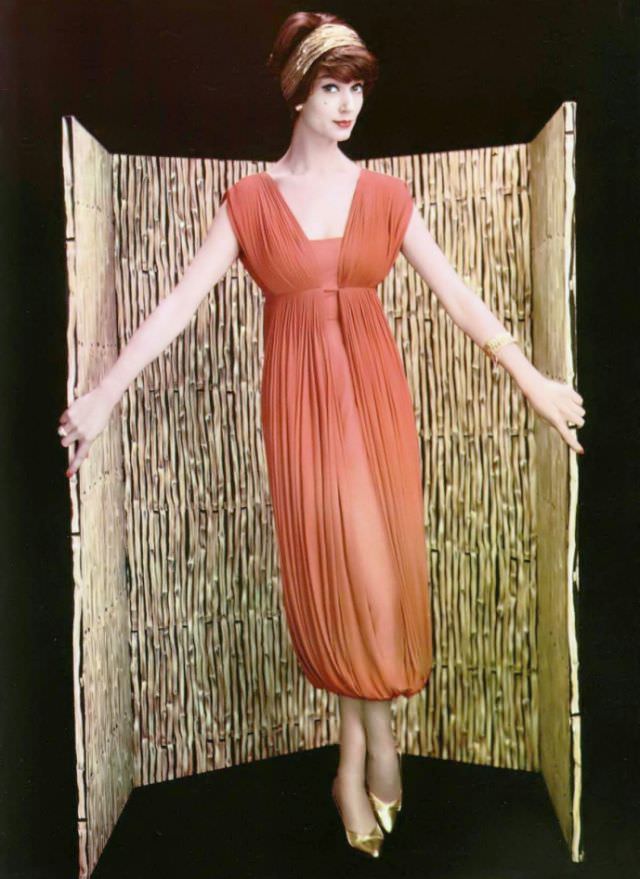
Simone d’Aillencourt stands poised with her arms extended, turning the frame into a stage for pure drapery. Behind her, a textured folding screen of reed or bamboo-like slats forms a quiet backdrop, letting the warm hue of the silk jersey take center focus. A matching headband and subtle jewelry echo the dress’s polished restraint, while the softly lit studio setting emphasizes the clean, sculptural line of the silhouette.
Madame Grès’s signature mastery of pleating is written into every fold: the fabric gathers at the bodice, flows through a cinched waist, and descends in controlled ripples that move like classical columns translated into couture. The neckline and cap-like shoulder line balance modesty and allure, and the skirt’s rounded, tapering shape hints at mid-century experimentation without sacrificing elegance. Even at a glance, the garment reads as engineered by hand, yet effortless in its fall—an haute couture paradox Grès was famous for achieving.
In the context of 1958 fashion and culture, the image celebrates a moment when Parisian couture asserted its artistry through technique rather than excess ornament. The silk jersey—fluid, modern, and demanding—becomes a medium for sculpture, transforming a simple textile into a statement of refinement. For anyone searching the legacy of Madame Grès, mid-century haute couture, or iconic fashion photography of the era, this portrait of d’Aillencourt distills the “crown jewel” reputation of Grès into a single, unforgettable pose.