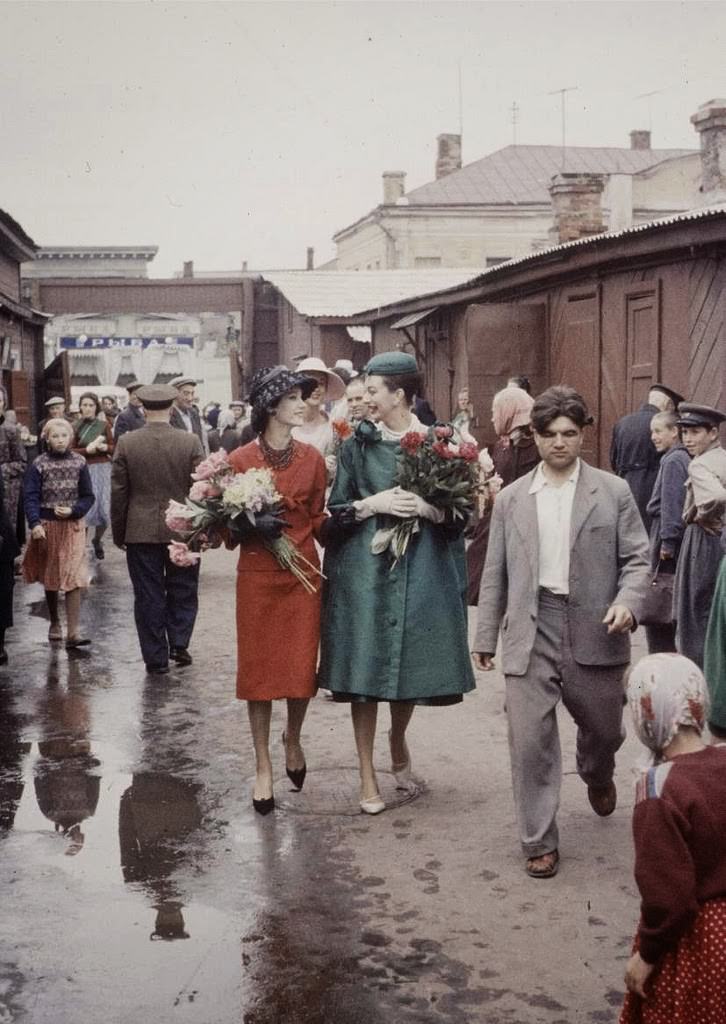
A wet Moscow street turns into an unlikely runway as two impeccably dressed women glide past onlookers, their arms filled with bouquets. The saturated reds and deep greens of their coats and hats—so crisp against the drab boards and muddy pavement—create the kind of visual jolt that explains the title’s “fashion shock” better than any caption could. Around them, everyday life continues: uniforms, headscarves, and workwear form a living backdrop, while curious faces track each step like a breaking news event.
1959 sits at a hinge point in Cold War culture, when exhibitions, delegations, and carefully managed encounters allowed Western style to briefly brush up against Soviet streets. In this scene, couture isn’t staged behind velvet ropes; it moves through a public thoroughfare, carrying the language of Dior—silhouette, poise, polish—into a setting built for practicality. The contrast is the story: a flash of Parisian elegance crossing paths with the rhythms of a city where clothing was often about function first.
Fashion & Culture come together here in the simplest way: through spectatorship, aspiration, and the politics of looking. Whether the crowd reads the outfits as glamorous, puzzling, or provocative, the moment documents how style can travel farther than ideology expects, altering a street’s atmosphere in an instant. For readers drawn to Dior, Moscow 1959, and the history of postwar fashion, this photograph offers a rare, street-level glimpse of couture as cultural encounter rather than mere clothing.