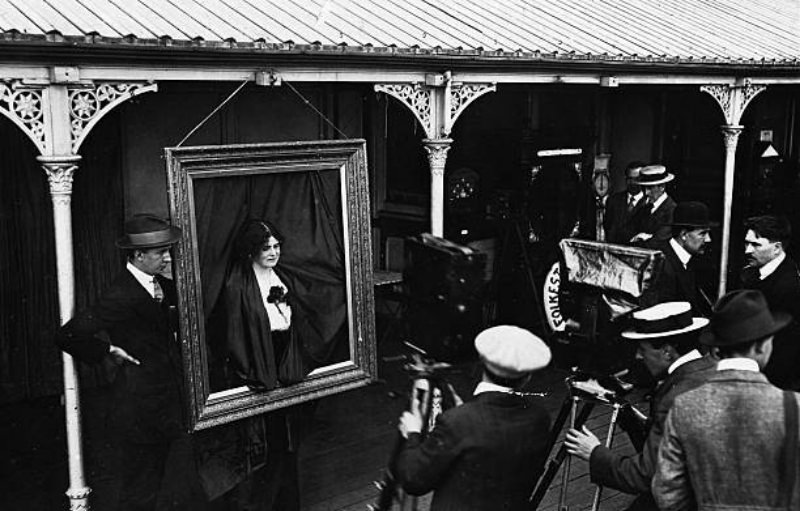
Under the ironwork of a seaside pavilion in Folkestone, a small crowd of suited men gathers around bulky cameras as a young woman stands posed within an oversized picture frame. The scene turns a winner of the 1913 beauty show into a living portrait, framed like a painting and set against a dark drape that sharpens her silhouette. It’s a clever bit of Edwardian stagecraft, designed for the press and for postcards, where the spectacle of modern celebrity could be neatly packaged and sold.
To the right, photographers and assistants lean in with tripods and equipment, their hats and collars forming a dense border of attention aimed at the subject. The practical mechanics of early photography are on display: careful positioning, controlled background, and a cluster of observers watching the moment of exposure. Even without hearing the instructions, the image conveys the choreography behind publicity pictures—everyone knowing their place, from the sitter to the men managing the apparatus.
Beauty contests in early twentieth-century England were as much about fashion and public entertainment as they were about individual winners, and Folkestone’s event highlights that blend of glamour and seaside leisure. The woman’s composed expression, the dramatic framing, and the presence of multiple cameras underscore how quickly pageantry and media learned to feed each other. For anyone searching Edwardian culture, British beauty pageants, or the history of photography in 1913, this photograph offers a vivid glimpse of how “beauty” was staged, recorded, and circulated.