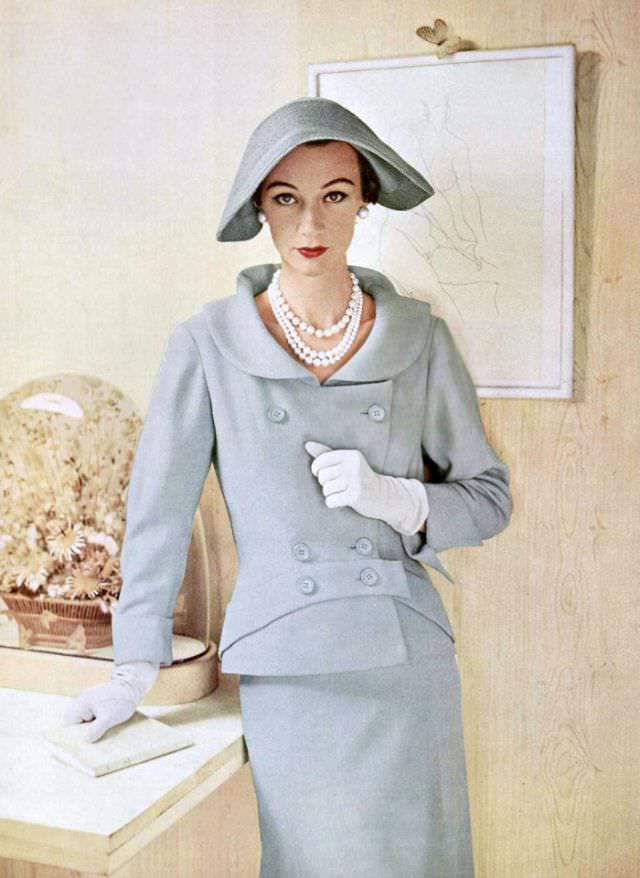
Poised against a softly decorated interior, Sophie Malgat wears a pale blue linen suit attributed to Jean Patou, a look that distills early-1950s French fashion into clean lines and quiet authority. The tailored jacket, with its sculpted collar and double-breasted buttons, creates a refined silhouette that reads crisp yet feminine, while the matching skirt falls in a smooth, uninterrupted column. A wide-brim hat in the same cool tone frames her face, making the pastel palette feel deliberate rather than delicate.
Details do much of the storytelling here: white gloves, luminous pearl earrings, and a layered pearl necklace bring classic elegance to the ensemble without competing with the suit’s architecture. Her makeup—defined brows and red lipstick—adds contrast and sharpens the overall impression, a hallmark of mid-century glamour. Even the relaxed pose, one hand resting on a tabletop, suggests a fashion editorial’s practiced ease, designed to sell both clothing and an aspirational mood.
Behind the model, the understated backdrop—floral-patterned walls, a framed artwork, and a simple arrangement on a side surface—keeps attention on texture and cut, letting linen and tailoring speak. The image aligns with the era’s postwar appetite for polished daywear and couture-adjacent refinement, when Parisian houses shaped international taste through magazine spreads and studio portraits. As a 1953 fashion moment, it offers a vivid snapshot of how Jean Patou style and French model glamour combined to define sophisticated, wearable elegance.