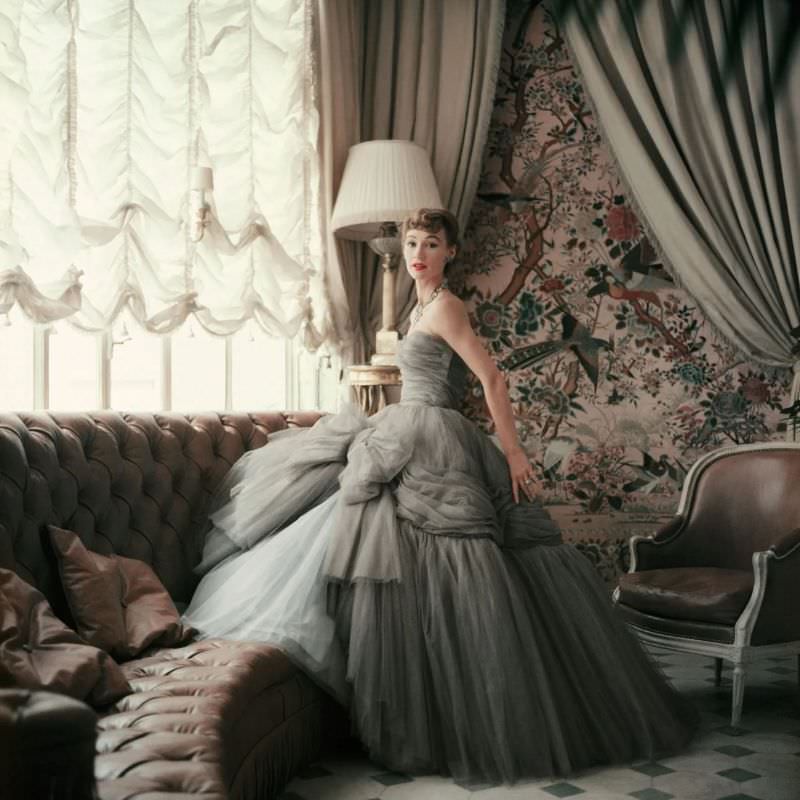
Poised beside a tufted sofa and framed by heavy drapery, Sophie Malgat appears in a dramatic Christian Dior gown photographed in November 1953. The dress is all sculpted volume—layers of airy tulle gathered into soft swells—balanced by a strapless bodice that draws the eye to her necklace and the clean line of her shoulders. Her turned posture and direct gaze give the scene the quiet confidence of mid-century couture, where elegance was staged as much as it was worn.
Light pours in from tall windows dressed with ruched sheers, catching the gown’s silvery gray tones and making the skirt read like a cloud against the darker furnishings. Behind her, a richly patterned tapestry or wall hanging introduces a garden-like motif that echoes the era’s taste for ornamental interiors, while a pleated lampshade and carved chair underline the domestic luxury of the setting. The checkered floor anchors the composition, adding a crisp geometric counterpoint to all that softness and drape.
More than a fashion portrait, the image works as a cultural snapshot of early 1950s French style, when Dior’s vision helped define the silhouette of the decade. The careful balance of haute couture and salon-like surroundings points to how fashion photography sold a complete fantasy—grace, comfort, refinement—along with the dress. For readers searching Dior 1953, Sophie Malgat, or classic French model glamour, this photograph remains a vivid reminder of couture’s theatrical craft and the era’s devotion to polished femininity.