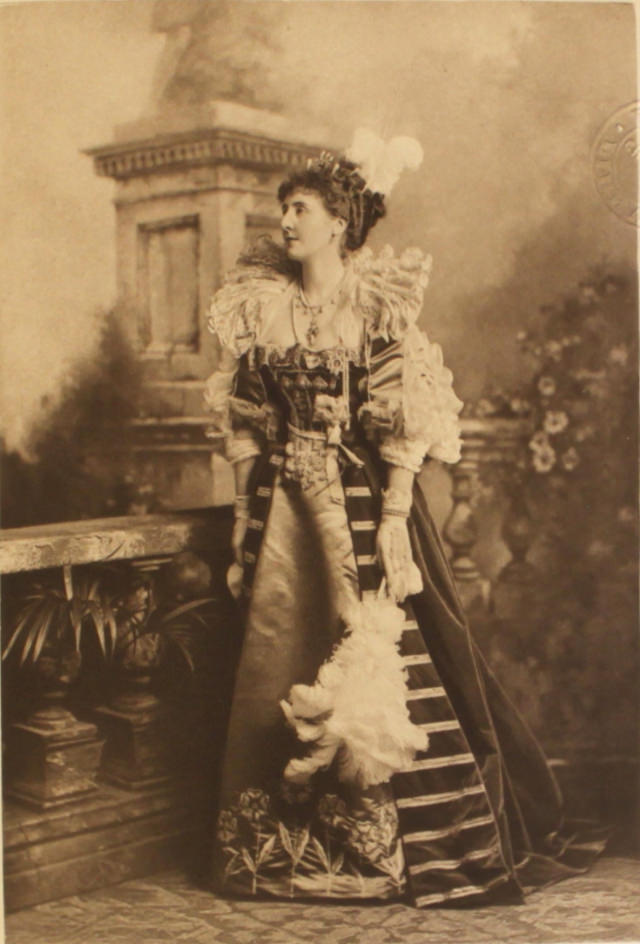
Poised in three-quarter profile beside a carved balustrade, Lady Meysey Thompson embodies Elizabeth, Queen of Bohemia with the practiced ease of late-Victorian high society costume drama. Her gaze turns slightly away from the camera, as if toward music or conversation just out of frame, while a painted backdrop of classical architecture and soft foliage lends a courtly, theatrical atmosphere. The sepia tones and studio lighting smooth the scene into something halfway between portrait and stage set, perfect for the pageantry associated with the Devonshire House Ball.
Rich textiles and carefully chosen details signal a deliberate historical revival: a structured bodice, lavish ruffled sleeves, and a long skirt edged with bold banding that reads as heraldic in spirit. A jeweled necklace and pendant catch the light at her throat, while her hair is dressed up with ornamentation that suggests court fashion rather than everyday wear. Even the placement of her gloved hand and the sweep of the train feel choreographed, reinforcing the period illusion prized in elite Fancy Dress culture.
The title’s reference to Elizabeth of Bohemia—remembered as the “Winter Queen,” kin to the Stuart line and consort of Elector Frederick V—adds layers beyond costume and society spectacle. In modern retellings she has also become a touchstone in esoteric history, her court and legend woven into later narratives about hidden traditions, symbolism, and intellectual networks. Seen through that lens, the portrait works as both Fashion & Culture artifact and historical imagination: an Edwardian-era homage that refracts a seventeenth-century figure through the tastes, nostalgia, and mythmaking of its own time.