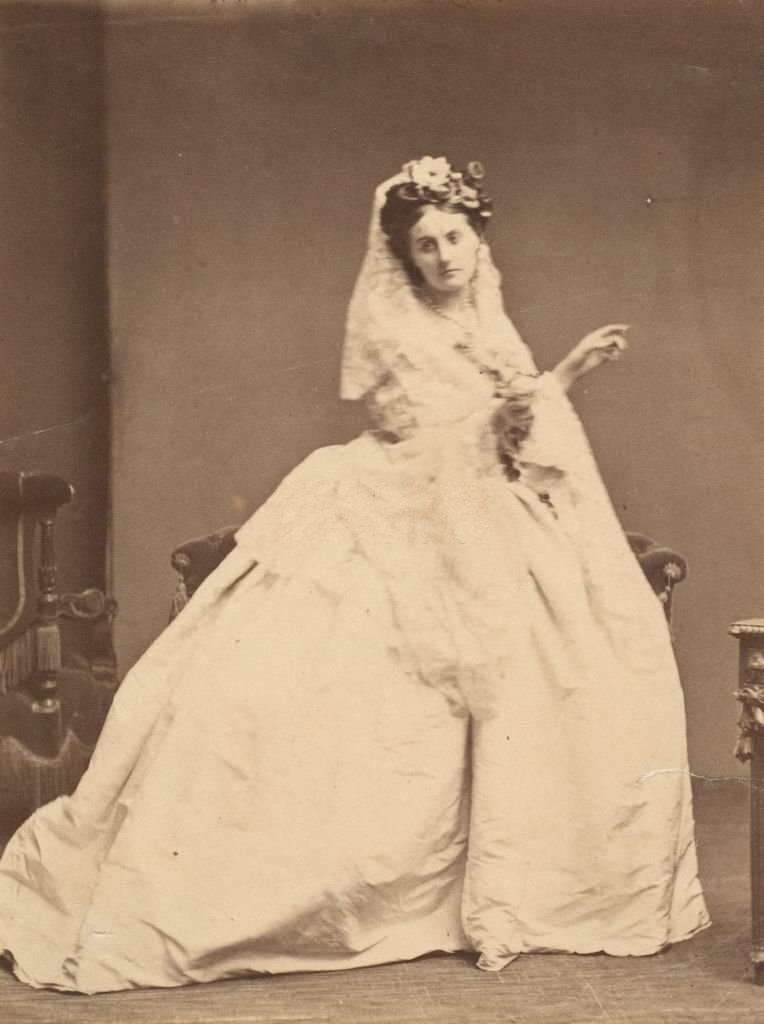
Silk and structure dominate the scene as a woman poses in a dramatically full bouffante gown, the skirt fanning outward in a broad dome that signals the crinoline era of the 1860s. A lace veil frames her face and cascades over her shoulders, while floral adornments in her hair lend a ceremonial, carefully arranged finish. The plain studio backdrop pulls attention to the dress’s volume and sheen, letting the fashion itself become the subject.
The silhouette tells a story of 19th-century women’s fashion built on engineered underpinnings, with hoops or cage crinolines lifting fabric into sculptural form. Soft folds and faint creases in the skirt reveal the material’s weight and the way it responds to movement, even in a posed portrait. Her lifted hand and gentle turn of the body suggest the choreographed etiquette of studio photography, where posture helped display garments to best effect.
“La Robe Bouffante, 1860s” works as both a style document and a cultural snapshot, illustrating how clothing signaled status, modernity, and taste in the mid-Victorian period. Details like the veil, the fitted bodice, and the expansive skirt make this a valuable reference for researchers, costume designers, and anyone interested in crinoline dresses and Victorian bridal or formalwear aesthetics. In its quiet staging, the photograph preserves the grandeur—and the constraints—of an iconic fashion moment.