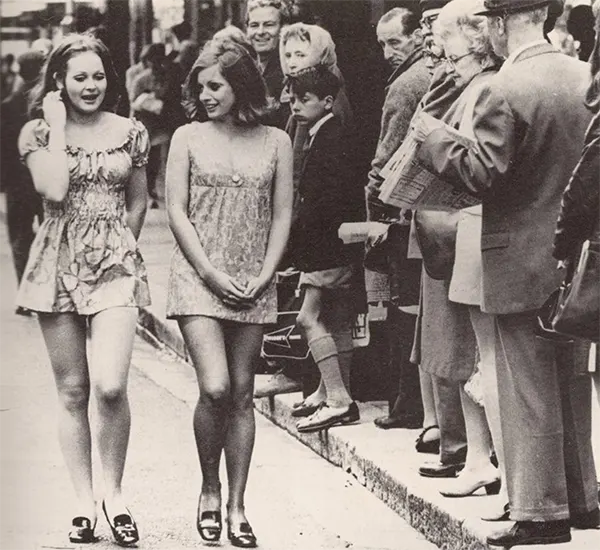
Sunlit pavement and a busy Cape Town sidewalk set the stage for two young girls strolling with the easy confidence of the mid-1960s. Their short, patterned dresses skim above the knee, paired with low-heeled shoes that read as both practical and stylish, the kind of everyday glamour that turned an ordinary errand into a small parade. One gestures as she talks, the other listens with a half-smile, their body language suggesting friendship and the unselfconscious rhythm of a city day.
Along the curb, a row of adults gathers in coats and tailored suits, some leaning forward to watch, others turned inward as if mid-conversation. A man holds a newspaper open, anchoring the scene in street life and public routine, while faces in the background create a soft crowd texture typical of candid urban photography. The contrast between the girls’ youthful silhouettes and the more formal, layered clothing of the onlookers highlights a generational shift in fashion and attitude.
Cape Town in 1965 appears here not as a postcard landmark but as lived-in modernity—curb, shopfront shadows, and the social theatre of the pavement. The photograph’s appeal lies in its fashion-and-culture detail: hemlines, hairstyles, and the way passersby register a changing world without posing for it. As a slice of South African street style, it preserves a moment when global trends met local streets, and two girls simply walking became an enduring image of era-defining confidence.