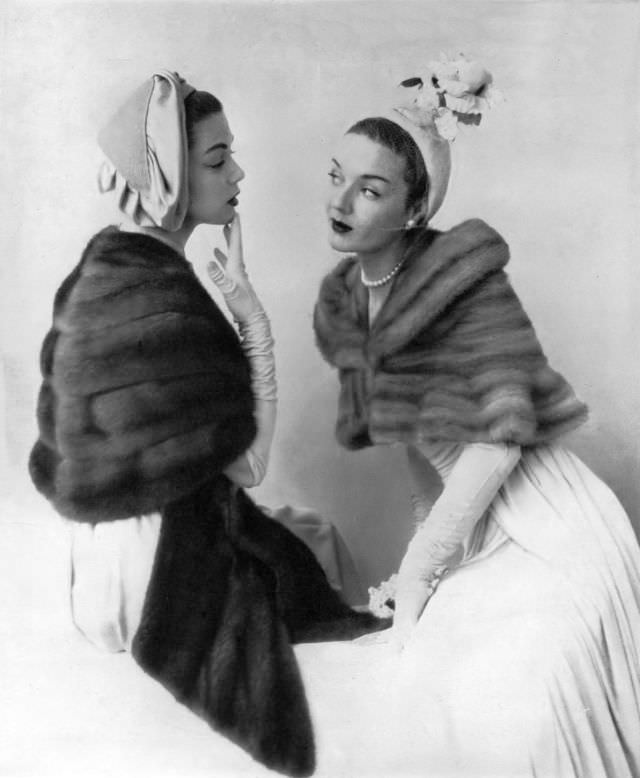
Poised in profile, Jean Patchett turns toward another model in a quiet, staged exchange that feels like a backstage whisper made glamorous. Both women are wrapped in mink—Patchett in a plush stole described as “Royal Pastel,” her gloved hand lifted near her lips, while her counterpart leans forward in a “Silver Blue” mantlet that frames the shoulders like a soft collar. The styling is pure Vogue 1949: sculptural hats, long white opera gloves, and lipstick-dark mouths set against a clean studio backdrop.
Bergdorf Goodman’s name anchors the scene in the world of luxury retail, where postwar fashion sold not only garments but a whole atmosphere of refinement. The fur pieces read as engineered elegance rather than mere warmth, with the mantlet’s convertible shoulder-cuff hinting at versatility and clever design for the cocktail hour and the winter social calendar. Even in black and white, the textures—dense pelts, satin-smooth gloves, and the gentle sheen of pearls—carry the image’s sensual appeal.
Kay Bell’s photographic approach emphasizes gesture and silhouette, letting the models’ bodies form a conversation of curves: one seated and contained, the other bending forward as if mid-sentence. The soft lighting flattens distractions and elevates the couture details, turning a fashion advertisement into an intimate portrait of 1940s style culture. For readers searching classic Vogue fashion photography, mid-century fur stoles, or Bergdorf Goodman glamour, the image stands as a distilled emblem of late-1940s American sophistication.