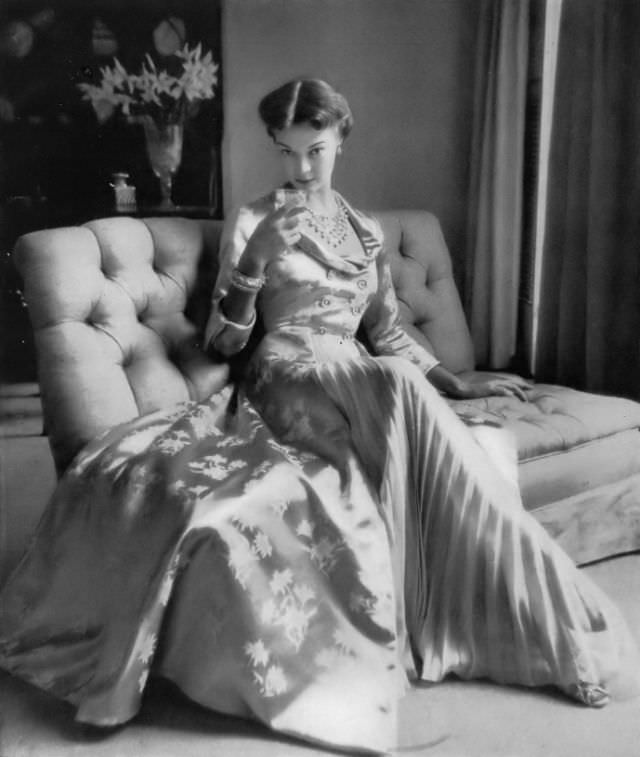
Poised on a tufted sofa, Jean Patchett meets the camera with a knowing, almost conspiratorial gaze, one hand lifting a small cup as if mid-toast. The setting feels intentionally intimate—soft drapery, a quiet floral arrangement in the background—so the focus stays on the commanding line of her silhouette and the controlled drama of her posture. Even in monochrome, the mood suggested by “tea-and-twilight” reads clearly: refined, nocturnal, and unmistakably Vogue.
The coat’s imported rayon brocade catches the light in broad, glossy planes, its pattern registering as a gentle shimmer across the sweeping skirt. A cut-away section reveals a pleated panel of silk chiffon, introducing movement and airiness against the heavier brocade, while the fitted bodice and sculpted shoulders keep the look crisp and architectural. Jewelry at the neckline and wrist punctuates the styling, reinforcing the mid-century fashion ideal of polish—luxury expressed through texture, tailoring, and restraint rather than excess.
Published in 1949 and associated with Bergdorf Goodman, the image sits at the crossroads of postwar aspiration and editorial sophistication, when American fashion culture increasingly framed department stores and couture-adjacent ateliers as gateways to modern elegance. The composition—lounging yet formal, domestic yet staged—captures how late-1940s fashion photography sold not only garments but a lifestyle of cultivated leisure. For collectors searching Vogue 1949 fashion, Jean Patchett portraits, or Kay Bell’s 1940s fashion photography, this photograph remains a compelling emblem of the era’s glamour and its carefully constructed femininity.