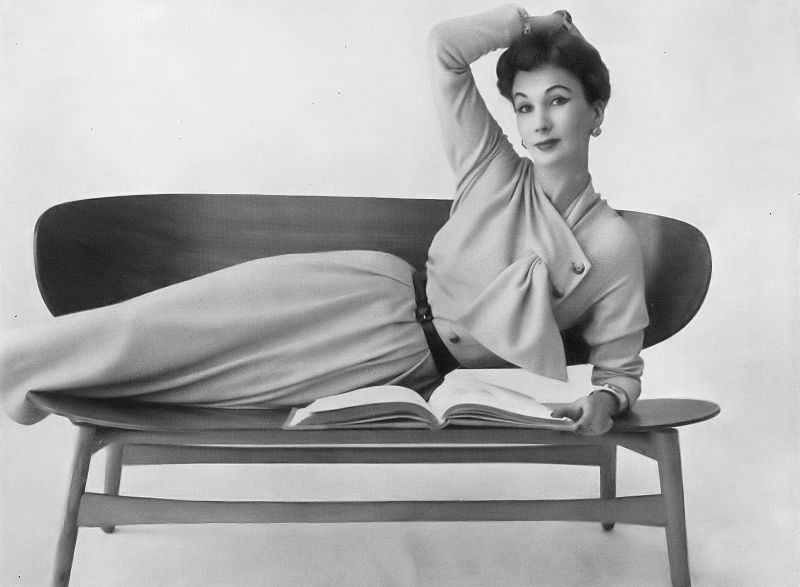
Barbara Goalen reclines with easy confidence along a sculptural, mid-century bench, turning a studio set into something that feels like a private sitting room. Her pose—one arm lifted, the other resting near an open book—balances poise and playfulness, the kind of controlled spontaneity that defined high-fashion imagery in the early 1950s. Against a clean backdrop, every curve of the furniture and line of the outfit reads crisply, letting the model’s expression and the garment’s silhouette do the storytelling.
The oatmeal wool jersey dress by Henry Gowns is built around quiet engineering: a side-fastened line that refines the waist and emphasizes a streamlined, modern shape. Soft drape through the skirt contrasts with a neat, buttoned bodice and a dark belt that anchors the look, while small earrings and a bracelet add polish without distraction. Texture is part of the appeal here—wool jersey suggesting comfort and movement—yet the overall effect remains sharply tailored, suited to the era’s taste for practical elegance.
Fashion and culture meet in this 1953 portrait, where the staging hints at leisure and intellect while selling an aspirational wardrobe for everyday life. Goalen’s relaxed glamour signals a postwar shift toward sleek, simplified dressing and sophisticated editorial poses that helped define British style on the international stage. For anyone searching vintage fashion photography, 1950s dress design, or Barbara Goalen’s iconic modeling images, the photograph offers a succinct lesson in how restraint can look utterly commanding.