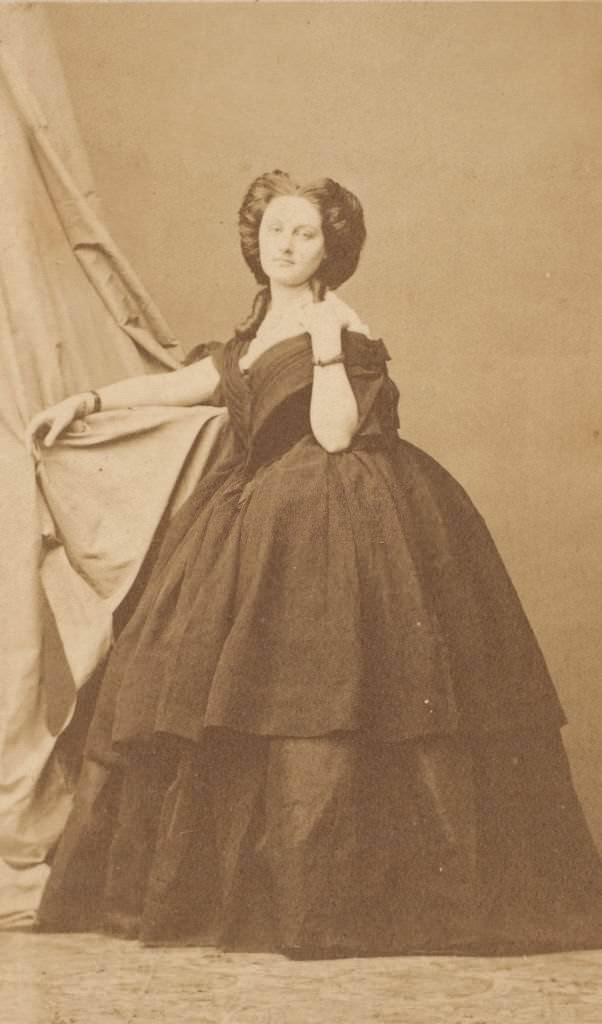
Elegantly posed beside a draped studio backdrop, a young woman stands in a sweeping crinoline dress whose bell-shaped skirt dominates the frame. The off-the-shoulder bodice and softly arranged sleeves draw the eye upward, while her hair is styled in a broad, sculpted arrangement that echoes the era’s taste for careful symmetry. Even in the stillness of early photography, the portrait carries a sense of performance—poise held long enough for the camera to register every fold of fabric.
The title, “The Beautiful Arm,” hints at a Victorian fascination with controlled display: a glimpse of shoulder, the line of a forearm, the suggestion of grace rather than outright exposure. Her raised hand and slightly turned torso emphasize that idea, turning an ordinary gesture into a statement about refinement and femininity. Such fashion photography of the 1860s often balanced modesty with allure, using posture and clothing design to communicate status, taste, and the period’s idealized silhouette.
Beyond its immediate charm, the image is a vivid document of 19th-century fashion and culture, capturing how crinolines reshaped women’s clothing and the spaces they occupied. The layered skirt, structured volume, and studio setting speak to a world where garments were engineered as much as sewn, and portraits served as lasting proof of style. For historians and collectors searching for authentic Victorian dress imagery, it offers a clear, memorable example of mid-century portraiture and the era’s iconic crinoline look.