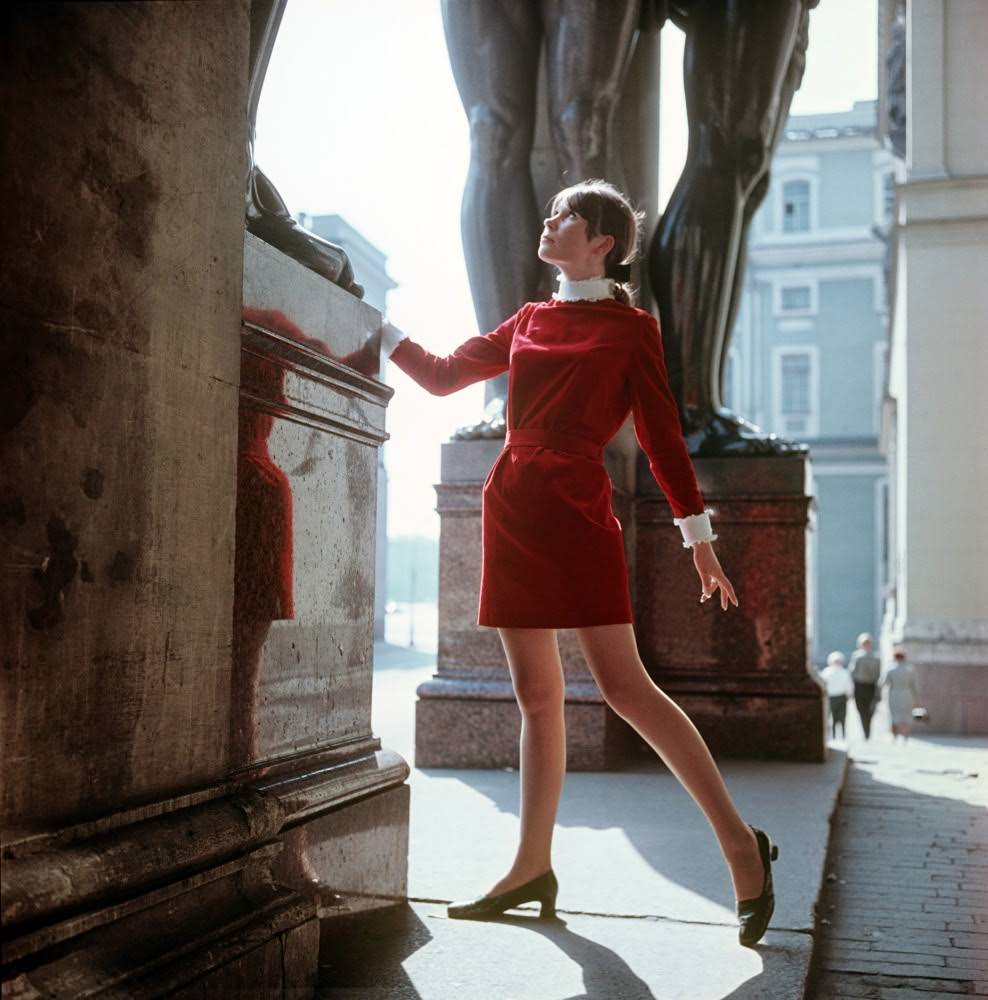
Sunlight pours through a monumental city colonnade as a young woman pauses beside a stone pedestal and towering bronze statues, turning her face toward the brightness. Her outfit commands attention: a deep red mini dress with a slim belt, crisp white collar and cuffs, and neat low heels, creating a bold silhouette that feels both playful and composed. The contrast between her vivid look and the heavy grandeur of the architecture underscores the era’s fascination with modern style set against enduring public spaces.
Within the frame, Soviet women’s fashion of the late 1960s and 1970s comes through as a blend of clean lines, practical tailoring, and carefully chosen flair. The shorter hem, structured shoulders, and graphic color blocking suggest how global trends were interpreted through local taste—often emphasizing polish over excess. Even in a seemingly candid street moment, the styling reads intentional, as if everyday life could double as a quiet runway.
Behind her, distant pedestrians and the softened outlines of buildings hint at an ordinary urban rhythm, while the statues lend a sense of scale and cultural weight. That tension—between individual expression and the monumental setting—captures why Soviet fashion and culture remain so compelling: style was a personal language spoken in public, negotiated in light, shadow, and stone. The photograph invites a closer look at how confidence, youth, and a carefully tailored dress could stand out in the vastness of the city.