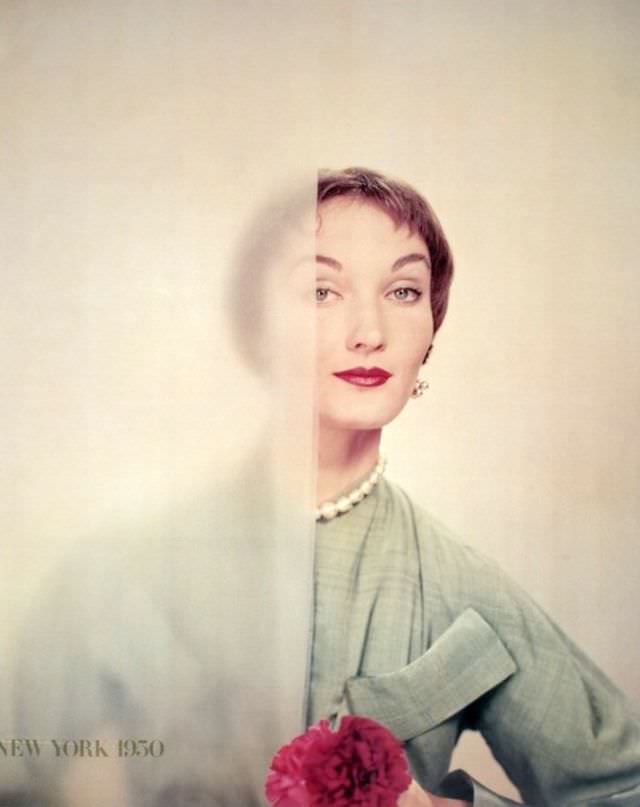
Evelyn Tripp appears half-veiled by a soft, milky blur, her calm gaze and vivid lipstick brought into sharp relief against a pale studio ground. The effect feels like looking through frosted glass: one side of her face is crisp and luminous, while the other dissolves into atmosphere. A single strand of pearls and delicate earrings punctuate the refinement, and the styling keeps the viewer’s attention on line, tone, and poise rather than cluttered surroundings.
Jacques Fath’s dress reads as mid-century couture at its most sculptural, with a gently structured shoulder and a wrapped, draped bodice that falls in controlled folds. The muted fabric lets texture do the talking, while a bold floral accent near the waist provides a concentrated burst of color and drama. Everything in the ensemble—pearls, tailored silhouette, and understated elegance—suggests the postwar appetite for polish and modern femininity.
Erwin Blumenfeld’s fashion photography turns a simple portrait into a lesson in visual persuasion, using selective obscuration to heighten glamour and mystery. The composition balances softness and precision, inviting the eye to travel between the blurred plane and the sharply rendered features, a signature trick of modernist studio experimentation. As a 1950 fashion and culture artifact, the image markets not just a garment, but a whole ideal of sophistication—couture as artistry, and the model as an icon of taste.