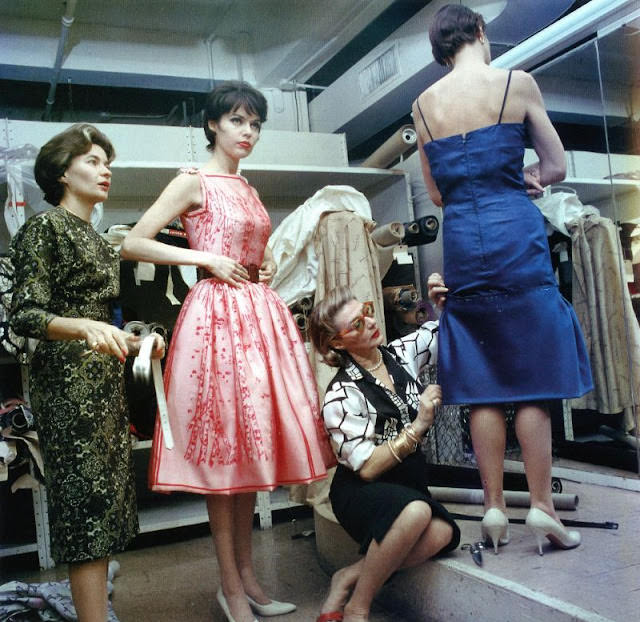
In a busy workroom moment from 1962, designer Pauline Trigère appears mid-fitting as two models stand poised under bright studio lights. One wears a pink, full-skirted dress that catches the eye with its delicate patterning and sheen, while another turns away in a sleek blue sheath, the back seam and hemline presented for scrutiny. The scene feels immediate and practical—fashion not as runway spectacle, but as craft in progress.
To the side, fabric bolts and garments crowd open shelving, suggesting an atelier environment where choices are made quickly and materials are always within reach. A crouched figure adjusts the blue dress near the knees, hands at work with the concentration of someone measuring millimeters rather than inches. The models’ neutral heels, composed posture, and stillness contrast with the controlled bustle around them, turning the fitting into a small drama of precision.
Color plays a crucial role in the photograph’s appeal, aligning with Ormond Gigli’s celebrated ability to render 1960s fashion culture in vivid, cinematic tones. The pink dress reads as youthful and romantic, the blue as modern and streamlined, together mapping the era’s tension between feminine volume and the rising dominance of clean, body-skimming silhouettes. More than a behind-the-scenes view, the image serves as a tactile record of mid-century design practice—where the final look is negotiated stitch by stitch, under the watchful eye of an exacting couturier.