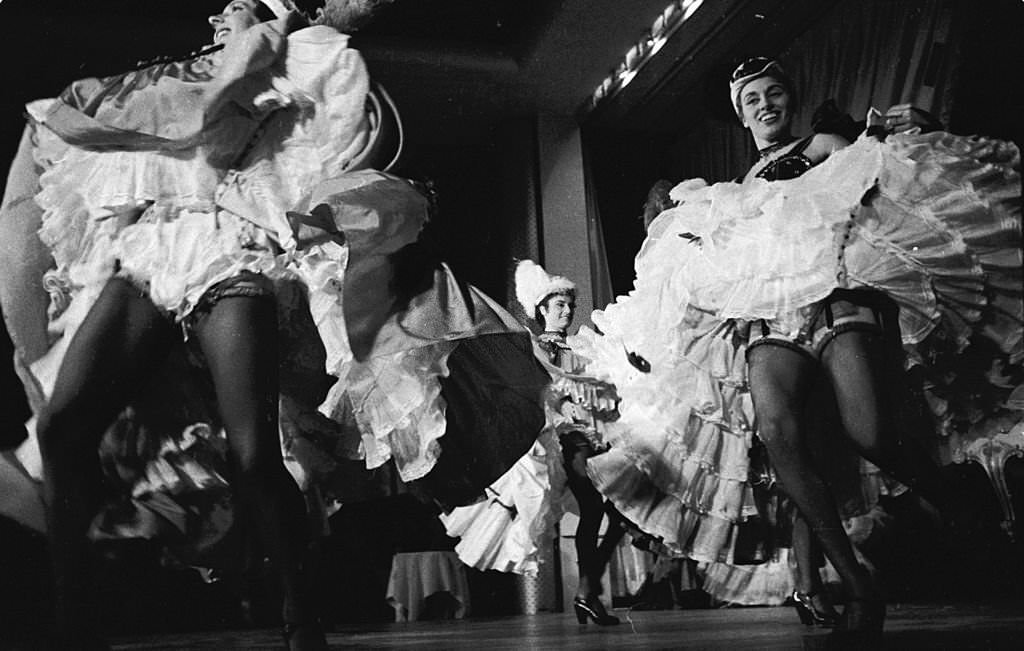
Feather-light ruffles explode into motion as a line of can-can dancers lifts and whips their skirts in unison, turning the stage into a blur of lace and legs. Shot from a low angle, the photograph heightens the spectacle: stockings, garters, and polished heels dominate the foreground while the dancers’ faces flash in and out of the swirling fabric. One performer at right beams toward the audience, her smile cutting through the frenzy of movement.
Regine is presented as part of a tightly drilled troupe, where individuality and choreography meet—each kick and skirt flourish timed to the same musical pulse. The layered costumes, with their bright whites and deep shadows, read like a moving set piece, designed to catch the light and amplify every turn. In the background, the curtain and stage architecture suggest the classic cabaret environment, a space built for glamour, rhythm, and controlled daring.
Moulin Rouge in Paris is more than a venue here; it acts as a symbol of postwar nightlife and enduring French entertainment culture, with the can-can serving as its most instantly recognizable signature. The 1955 setting places the performance in a period when cabaret was both tradition and modern attraction, marketed to locals and visitors alike as a must-see Paris experience. What lingers is the physicality—the demanding athletic precision—wrapped in theatrical joy, a snapshot of show business at full speed.