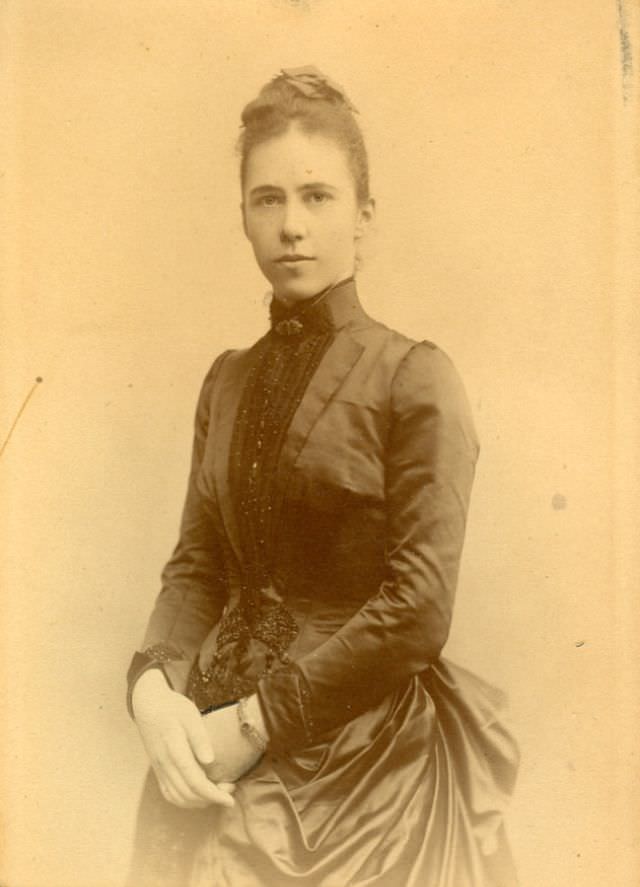
Poised and unsmiling, a young Victorian woman faces the studio camera with hands neatly folded, her posture carefully arranged to project calm respectability. The high, dark collar and fitted bodice draw the eye upward to her composed expression and tidy updo, while the sheen of the dress fabric suggests a garment meant to be seen, not merely worn. Even without showing the underlayers directly, the silhouette—narrowed at the waist and structured through the torso—signals the shaping power of the corset that defined late 19th-century fashion.
Beneath such polished outerwear lay an indispensable undergarment that was as much technology as tradition: boning, lacing, and stiffened panels engineered the fashionable figure of the era. Corsets supported heavy skirts and tailored jackets, smoothed lines under satin and wool, and helped create the upright stance expected in formal portrait photography. The tension between comfort and appearance, personal choice and social pressure, is written into the very geometry of the outfit: rigid verticals at the front, controlled curves at the waist, and carefully managed drapery at the hips.
Seen today, portraits like this offer more than a study of “tight corsets” and Victorian beauty—they open a window onto everyday ideals of femininity, discipline, and class presentation. Studio photographs rewarded stillness and precision, and the clothing had to cooperate, turning the body into a kind of architecture that read well on early photographic plates. For readers interested in Victorian-era corset history, women’s fashion, and 19th-century culture, this image stands as a quiet reminder that style was built layer by layer, shaping both how women looked and how they were expected to be seen.