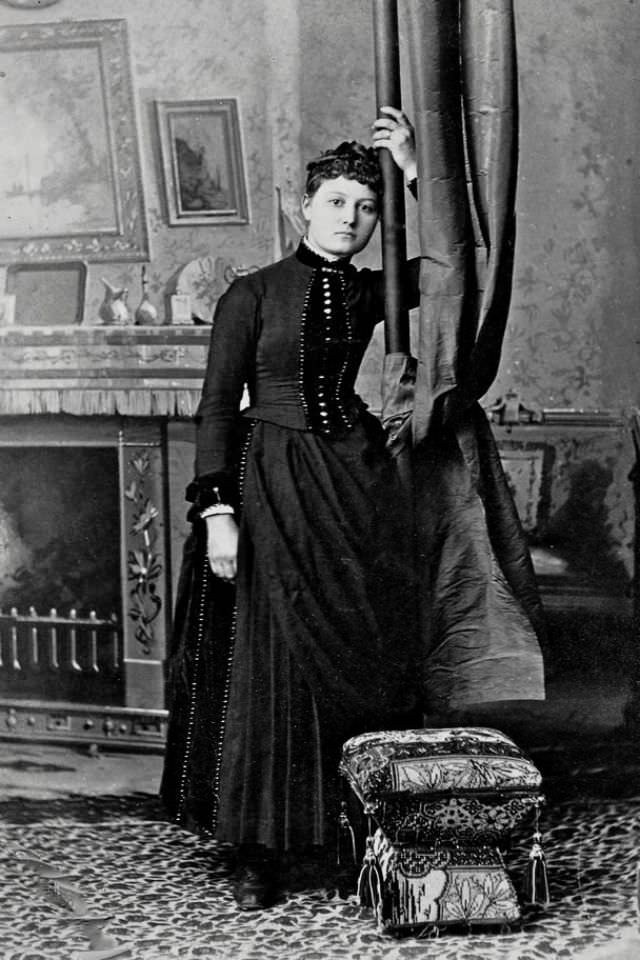
Poised beside a heavy studio drape, a Victorian woman stands with a calm, direct gaze that feels both guarded and self-possessed. Her dark dress—high-necked and tightly fitted through the bodice—falls into a long skirt that pools toward the patterned carpet, the fabric reading as substantial and carefully kept. Rows of small buttons and neat cuffs draw the eye to the tailored silhouette that defined late 1800s fashion, where modesty and precision were marks of respectability.
Behind her, the staged interior hints at the visual language of portrait studios: a painted backdrop, framed pictures, and a decorative mantel that suggests domestic comfort without committing to a specific home. The arrangement speaks to aspiration as much as realism, offering viewers a setting that reinforces refinement and gentility. Even the ornate footstool in the foreground—richly patterned and tasseled—adds to the sense of curated elegance, a prop chosen to signal taste and material culture.
As a window into Victorian fashion and culture, the portrait reveals how clothing functioned as social communication: structured lines, controlled adornment, and an overall restraint that emphasized propriety. The woman’s stance—one hand resting high on the curtain support—introduces a subtle dynamism, a touch of individuality within formal conventions. For anyone exploring late 19th-century style, this image delivers the era’s hallmarks in one frame: meticulous dressmaking, theatrical studio presentation, and the quiet power of being seen on one’s own terms.