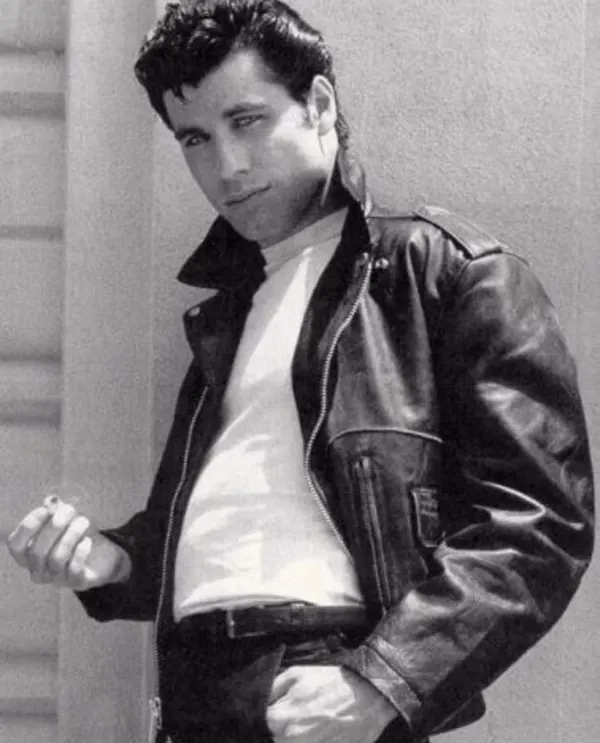
Leaning with a relaxed confidence, John Travolta appears as Danny Zuko in “Grease,” wearing the unmistakable greaser uniform: a glossy black leather jacket over a plain white T‑shirt, cinched with a dark belt and paired with fitted trousers. The slicked, carefully sculpted hair and the slightly raised collar do as much talking as his expression, projecting cool without effort. Shot in a tight, poster-like framing, the image keeps attention on silhouette, texture, and attitude.
Danny’s styling draws directly from 1950s youth culture as it was later remembered—rebellious, romanticized, and built around a few iconic pieces that signaled belonging. The leather jacket reads as armor, equal parts streetwise swagger and movie-star polish, while the simple shirt underneath suggests a working-class ease that Hollywood often turned into myth. Even the casual hand gesture feels like a performance of nonchalance, the kind that made greaser fashion a lasting symbol of teenage identity.
As a piece of pop-culture history, the photo works like a visual shorthand for “Grease” itself: a stylized throwback where fashion and character are inseparable. It’s the sort of image that fueled decades of Halloween costumes, retro lookbooks, and search terms like greaser style, leather jacket 1950s, and Danny Zuko outfit. More than a film still, it’s a snapshot of how cinema can define an era’s look—whether or not it ever belonged to just one real decade.